CONTEXTUAL STUDIES

WEEK 1: tutor Chis Aughton. 26,09.2011

This module is to give students a understanding of different cultures and there artifacts in accordance to each society.Each week within the lecture there will be a theme, this will explained and discussed within the group.
WEEK 1: tutor Chis Aughton. 26,09.2011
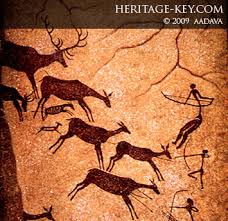
Lascaux Paintings

Cave art
Lectures are based on history, art, and design. Discussions will be raised in these core groups. Culture is simply a reflection of society in which it’s made i.e. Books, buildings, objects, clothes, visual manifesto - these are expression of emotion and a record of the time in society. These help us understand each culture and there societies within them.
Cave art dates back 30,000 years only natural materials were used e.g. stone, oxide, charcoal, ochre, hematite, manganese. Why did these people make art it could have been several reasons, statue, and power, education, to show a way of life?.Statues figures of fat women were seen as motherhood. They also could have been to show off to other tribes that they were more wealthy and powerful.
cave art
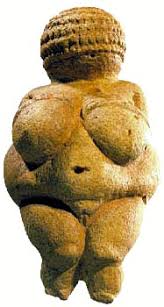
Venus of Wilendort.
(it's said to be seen as the portrayal of the perfect women of her time )
This shows to me that women had little or no status within there society because these statues showed ’no face ‘meaning to me that the mass majority of men claimed that this was there perfect women of its time .This is very similar to how the media portray woman today e.g page three girl or airbrushing photos . Women in Roman time were highly valued in there society for educating there children and producing the next generation of workers therefore women than were still oppressed and exploited.Has they are today.

Lion Man
CRITICAL STUDIES SEMINAR. week 1 : tutor Katy Suggitt.
Discussion was taken place to express the understanding how art first started from. The group also discussed about other photographers such as JR and Ted.com/talks. We were told to bring in a shoes box so we can make a Pin-hole for week 2.
I really didn't know who ' jr' the artist was until i researched him , i found him fascinating and intriguing .I think he is trying to get political views across to the media but at the same time jr is wanting public admiration for his art.
| JR | |
|---|---|
| Nationality | France |
| Field | Street art, graffiti |
.jpg)
JR's work combines art and action and deals with commitment, freedom, identity and limits.(http://www.jr-art.net/).
References:
This week in critical studies the lecture was on Egyptian, Greek and Rome art. Egyptian art was based on a 2D effect carved in to stone which included text, these figures were created a supreme power status ,these figures of Egyptian man where carved into what they thought was perfect body shape, should be e.g. long neck tall hats slim but tall bodies .On the other hand The Greeks took some of these ideas and developed them further e.g. free standing statues but there body’s shapes where out of per-position e.g. long legs , arms, large frames and small penis, but the Greek where known for there great building ,and the use of colour ,e.g. painting of statues , walls, and the mosaic which are small pieces of coloured glass or stone. The Romans culture after over taking the Egyptians expressed there sexuality though graphite sculptures and caving stories of soldiers in war e.g. Trajan column. Even today we still portray a type of body image by using e.g. photoshop , as the Egyptians, Greeks and Romans used these for status and supreme power and wealth to intimate other societies, we use it for vanity and profit.

Trajans column, built in113 CE

Trajans column, built in113 CE
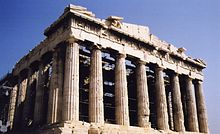
Pantheon in Rome
Critical studies seminar week 2 tutor 4,10, 2011
We brought a cardboard box into class and lined it with black paper, taped all the corners so there would be no light coming into the box. Than I made two pinholes these will be my apertures, the holes were covered with tape and than I went into the dark room and placed a single sheet of light sensitive paper on the opposite side to the holes of the box, than closed the lid before leaving the darkroom. I went out side of the university building to expose the two holes of the camera one I did for 8 seconds and the second for 10 seconds. I really enjoyed making my own pin hole camera and learnt how to develop the picture in the darkroom. I think the picture turn out will for a first timer.

This is my picture created from the pin hole camera.
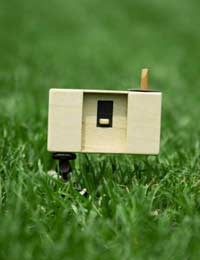 To make a pinhole camera you will need
.
.
What You’ll Need
- Cereal Box or Small/Medium Can (ideally with Plastic Lid)
- Black Paint
- Heavy Duty Aluminium Foil
- No. 10 Sewing Needle (1/75” diameter)
- Black Heavy Weight Card
- Black electrical tape
- Roll Film or Photographic Paper
- Safety Light (or red cellophane)
How To Make a Pinhole Camera
WEEK : 3 10. 10 2011 tutor Chis Aughton
This week Chris spoke about the art as a religious rhetoric and the role within Europe and the rise and decline of Christianity. Church funded works of art, but as Christianity decline so did the way art was produced they could no long afford to pay artist therefore the unskilled and unpaid workers (monks) started to produce painting that could only described as UN- scaled.
The decline over 320 years of the Roman Empire refers to the collapse of the info-structure which included religion, political and military.
Byzantine Empire art describes the artistic products from the 5th century until the fall of Constantinople in 1453 Byzantine influenced by ancient Geek art.

BIZANTINE work produced by monks.

Rabula Gospel, abstract and symbolic of nature.

Giotto painting
Hieronymus Bosch born in the Netherlands in 1450 till 1516 he was a painter, also his father ,uncles and siblings were also painters.Bosch was mostly well known for painting Triptychs- his most famous is The Garden f Earthly Delights.
Hieronymus Bosch born in the Netherlands in 1450 till 1516 he was a painter, also his father ,uncles and siblings were also painters.Bosch was mostly well known for painting Triptychs- his most famous is The Garden f Earthly Delights.
![[Bosch - The Garden of Earthly Delights on Canvas, Art Print, Poster]](http://www.artofeurope.com/bosch/bos1.jpg)
The Garden of Earthy
Delights
.
.
Pieter Bruegel: was born in the Netherlands in 1525 - 1569 .He comes from a family of artist and painters. His mean theme though out his painting was focused on painting peasants in vivid and usual ways.Many painting had children stories or proverbs.
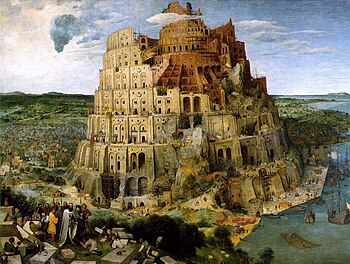
The Tower of Babel

Netherlandish Proverb
This my favourite picture which was shown at the lecture with Chris, to me it shows mass madness with a creative flare mixed with an in depth story lines.
Jan Van Eyck was born in the Netherlands in 1395 -1441. his most famous painting was a of Jodocus Vijdt and his wife Elisabeth Borluut. He started the painting in
1426 and completed it by 1432.This painting has been describes as the 'Final conquest of reality of the north ' . This polyptch painting has many meaning once you start looking closer for example the mirror shows a different reflection compared to the main picture indicating that his wife had past away during child birth.

WEEKS : 4 17,10 ,2010 tutor Chis Aughton
This week in Richard lecture we discussed the early and late renaissance. There were many names of painters and sculptors that came up on this lecture such as Botticelli/ Caravaggio /De Vinci/Michelangelo/ neo- classicism/Rococo/ Rembrandal/Titian/Velazquez/.I enjoyed this class today but there were alot of artist names to research this week.
Renaissance means the birth of a new wave of culture .The early renaissance is a period of history from the 14th to the 17th century, mostly in Italy, bridges the art period during the 15th century, between the middle Ages and the High Renaissance in Italy. This renewed interest came from ideas of ancient Greece and Rome. Painting context had changed from a spiritual context to harmonious proportion and, realistic expression.

Leonardo di Vinci in 1452 -1519 was in born Italy he was a painter, sculptor, architect, musician, scientist, mathematician, engineer, inventor, anatomist,geologist,cartographer, botanist and writer,he is said to be the greatest painter that has lived.He made important discoveries in civil engineering such as helicopter ,tank and solar power.His most famous oil paintings are Mona Lisa , The Last Supper and The Vitruvian man.On the other hand Florentine court records state in 1476 -1513 that Leonardo and three other young men were charged with sodomy and acquitted.

Mona Lisa
Mona Lisa was an oil painting on a popular panel which took several years to complete ( 1503-19) and is displayed in Musee Du Louvre in Paris .Mona Lisa real named is Lisa del Giocondo a member of the Gherardini family of Florence and Tuscany and the wife of wealthy Florentine silk merchant Francesco del Giocondo. The painting was commissioned for their new home and to celebrate the birth of their second son, Andrea.

The late supper -1490
Last Supper also known as the "communion is the final meal that, according to Christian belief, Jesus shared with his Apostles in Jerusalem before his crucifixion.
Last Supper also known as the "communion is the final meal that, according to Christian belief, Jesus shared with his Apostles in Jerusalem before his crucifixion.
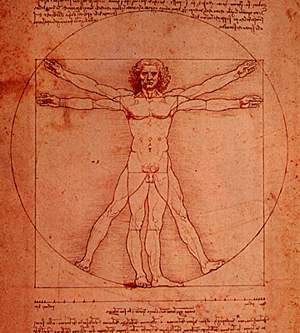
The Vitruvian Man -1487
These are notes drawn on paper by Leonardo di Vinci.
These are notes drawn on paper by Leonardo di Vinci.

Sandro Botticelli
Sandro Botticelli- was in 1445 -1510 born in Florence his real name is Alessandra di Mariana Fillipep. He never married and he was best known for his oil paintings in the early renaissance. "Botticelli keeps a boy", under an accusation of sodomy . The painter would then have been fifty-eight; the charges were eventually dropped. Mesnil dismissed it as a customary slander by which partisans and adversaries of Savonarola abused each other. Opinion remains divided on whether this is evidence of homosexuality .en.wikipedia.org/wiki/Sandro_Botticelli.

Venus and mars : 1483
This painting shows Roman gods Venus and Mars, while the infants are playing. This picture shows depth of field has the sea is set far into the distance and the gods are in the forest.
This painting shows Roman gods Venus and Mars, while the infants are playing. This picture shows depth of field has the sea is set far into the distance and the gods are in the forest.

Mystiacl Nativity 1500 - 1501
The painting shows the Virgin Mary and infant Jesus,s larger than the other figures, and their surroundings; this was said to be done deliberately for effect, as earlier Botticelli's use correct graphical perspective.
·

The birth of Venus. 1486

Ti Titian
T Titian place of birth is Italy but the date of birth was uncertain approx 1474. He belongs to the high renaissance and was well -known for his oil paints of portraits, landscape and backgrounds and mythological , religious subject and the use of colour which influenced other painters.
Titian's wife, Cecilia—a barber's daughter from his hometown village of Cadore—was a young woman who had been his housekeeper and mistress for some five years. Cecilia had already borne Titian two fine sons, Pomponio and Orazio, when in 1525 she fell seriously ill. Titian, wishing to legitimize the children, married her. The marriage was a happy one and Cecilia recovered and bore him two more children, both daughters. Only one of them, Lavinia, survived. Titian's favorite child was Orazio, who became.wikipedia.org/wiki/Titian.

Venus of Urbino: 1553
The frankness of Venue's expression is often noted; she stares straight at the viewer, unconcerned with her nudity. In her right hand she holds a posy of roses whilst her left covers her vulva (she seems to toy with a strand of pubic hair), which is provocatively placed in the center of the composition. In the near background is a dog, often a symbol of fidelity
Marie Magdalen :1538
Jesus cleansed her of "seven demons". She became most prominent during his last days, being present at the cross after Crucifixion. She was the first person to see Jesus after his Resurrection .

Diego Velazaquez
Diego Velazaquez was born in Spain in 1599 - 1660. He was an artist in the court of King Philip IV. He was an individualist artist and well known for painting historical , cultural scenes ,dwarfs and The Spanish Royal family. Diego married Juan Bautista and had two children but one died in infancy.

Portrait of pope and innocent 1650.
It,s said that he did a warm - up portrait painting of Juan de Pareja before painting the oil painting of the Pope.

Lus Meninas:
1656
The painting appears to centre around La Infanta Margarita, aged 5, who is surrounded by her ladies in waiting (or meninas), the family dog and two dwarves. Whilst most people's attention seems to be on her, Velázquez has once again proved that those people normally kept 'behind the scenes' (like the princess' maids of honour), are also worthy of being painted. The fact that the picture is entitled 'Las Meninas' reinforces this. To the left of Margarita we find Velázquez himself, paintbrush and easel in hand, poised in front of an enormous canvas. By including himself in the main part of the painting Velázquez is asserting his own position as an artis
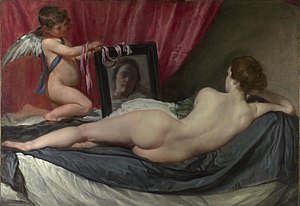
The Rokeby Venus 1647-51
The dwarf Francisco Lezcano called 'El Nino De Valleca'
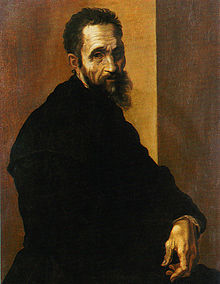


Michelangelo
Michelangelo was born in Italy in 1475 -1564.He is well known for being a architect ,engineer and sculptor " David " being the most famous sculptor of all time and painting the Sistine Chapel in Rome in 1508-12 which took him 4 years to complete.Critics believe that he expressed his sexuality though his nude sculptor.
Sistine Chapel in Rome.
These paintings took for years to complete 1508-12

Creation of Adam
There were four paintings of the creation of adam the first one was made of bonze engraving by Lorenzo Ghiberti 1425 -52
The second was a marble carving made by Andrea Pisano in the mid 14th century.
The third was a painting done by Tintoretto from approx 1550.
The four was done by Michealangelo which part of his fresco in the sistine chapel 1510.

The last judgement 1537-41
Michealangelo was accussed of immorality and intolerable obscenity because he painted nude figures clearly showing genitals. After 24 years the council of Trent condemnend nudity therefore the gentials were painted over .
.jpg)
Creation,

Pieta: 1499
This is a depiction of the body of Jesus on the lap of his mother Mary after the crucfixion.

Statue Of David :1504
He was asked to complete an unfinished project which begun 40 years earlier by Agostino di Duccio a colossal statue portraying David as a symbol of Florentine freedom, to be placed in the Piazza della Signoria, in front of the Palazzo Vecchio.

CARAVAGGIO
Michelangelo Merisi da Caravaggio was born in 1571-161o in Italy. His paintings suggest a realistic observation in the human body ,physical and emotional as well as being classed as chiaroscuro and theatrical. Most of is oil paintings were on canvas .Caravaggio private life was tumultuous and notorious for brawling.
"In1606 he killed a young man in a brawl and fled from Rome with a price on his head. He was involved in a brawl in Malta in 1608, and another in Naples in 1609, possibly a deliberate attempt on his life by unidentified enemies. This encounter left him severely injured. A year later, at the age of 38, he died of a fever in Porto Ercole, near Grosseto in Tuscany, while on his way to Rome to receive a pardon"
.wikipedia.org/wiki/Caravaggio

Judith beheading Holofernes: 1530

David and Goliath
David and Goliath in the Prado was painted in the early part of the artist's career, while he was a member of the household of Cardinal Francesco Maria Del Monte. It shows the Biblical David as a young boy (in accordance with the Bible story) fastening the head of the champion of the Philistines, the giant Goliath, by the hair. The light catches on David's leg, arm and flank, on the massive shoulders from which Goliath's head has been severed, and on the head itself, but everything else is dark. Even David's face is almost invisible in the shadows. A wound on Goliath's forehead shows where he has been felled by the stone from David's sling. The overwhelming impression is of some action intensely personal and private - no triumph, no armies, no victory.
David and Goliath in the Prado was painted in the early part of the artist's career, while he was a member of the household of Cardinal Francesco Maria Del Monte. It shows the Biblical David as a young boy (in accordance with the Bible story) fastening the head of the champion of the Philistines, the giant Goliath, by the hair. The light catches on David's leg, arm and flank, on the massive shoulders from which Goliath's head has been severed, and on the head itself, but everything else is dark. Even David's face is almost invisible in the shadows. A wound on Goliath's forehead shows where he has been felled by the stone from David's sling. The overwhelming impression is of some action intensely personal and private - no triumph, no armies, no victory.

Sleeping Cupid : 1608
Unlike manyKnights of Malta.

Rococo Queluz Palace is a Portuguese 18th-century palace located at Queluz. One of the last great Rococo buildings to be designed in Europe, the palace was conceived as a summer retreat for Dom Pedro of Braganza later to become husband and then king consort to his own niece, Queen Maria I. It served as a discreet place of incarceration for Queen Maria as her descent into madness continued in the years following Dom Pedro's death in 1786. Following the destruction by fire of the Ajuda Palace in 1794, Queluz Palace became the official residence of the Portuguese prince regent, John VI1, and his family and remained so until the Royal Family fled to Brazil in 1807 following the French invasion of Portugal.
W In 1908, it became the property of the state. Following a serious fire in 1934, which gutted the interior, the palace was extensively restored, and today is open to the public as a major tourist attraction.www.golisbon.com/Portugal/cities/queluz.ht
Arch of Ferdinand.
On the 28th of June 1914 Arch Duke Franz Ferdinand of Austria and his wife of Sopie Duchess of Hohenberg were shot dead in Sarajevo capital of Bosnia, by Gavrio Princia one of a group of six Bosnian Serb assassins.
WEEK : 4 critical 7, 10 11 critical seminar Katy Suggitt
This week we discussed the lecture on renaissance, Katy also talked about mind mapping..
This week we discussed the lecture on renaissance, Katy also talked about mind mapping..
w week: 5 Chis Aughton contextual lecture.
4 This weeks lecture was about romanticism, impressionism, neo - classical and the decline of secularisation. There were new academies opening up for more of an educational reason compared to a form of a craft or commission based. The artistes that we discussed this week were, Vermeer/ Geogre Stubbs/Poussin/Rembrand/ Cole Thomas /TheodoreGoya/Turner//Gauguin/Degas/Constable/Monet/Niepce/Von gogh/Schiele/ Klimt.
Vermeer was born in The Netherlands in 1632-75 he came from the Barque movement .He was deeply influenced by Leonaert Bramer, Dirck Van Barburen and Carel Fabritius. He was well known for his oil paintings on canvas and the use of bright colours and pigments.His must favourite colours were cornflower blue and yellow.Vermeer is also well known for the use of light, painting mainly women within there home in small rooms.

The Procures 1656 ; the figure on the left is a self portrait of Vermeer.
Vermeer was born in The Netherlands in 1632-75 he came from the Barque movement .He was deeply influenced by Leonaert Bramer, Dirck Van Barburen and Carel Fabritius. He was well known for his oil paintings on canvas and the use of bright colours and pigments.His must favourite colours were cornflower blue and yellow.Vermeer is also well known for the use of light, painting mainly women within there home in small rooms.
In 1625 Reijnier Vermeer's father was involved in a fight with a soldier named Willem van Bylandt, who died from his wounds five months later. Around this time Reijnier began dealing in paintings. In 1631 he leased an inn called "The Flying Fox". In 1641 he bought a larger inn. When Vermeer father died in 1652 he took over the family art business. The only sad part of this research is that I found out was that his work was over looked for almost 200 years, by other artist, mind you running a business and having14 children I,m surprised he knew what time of the day it was .
The Procures 1656 ; the figure on the left is a self portrait of Vermeer.


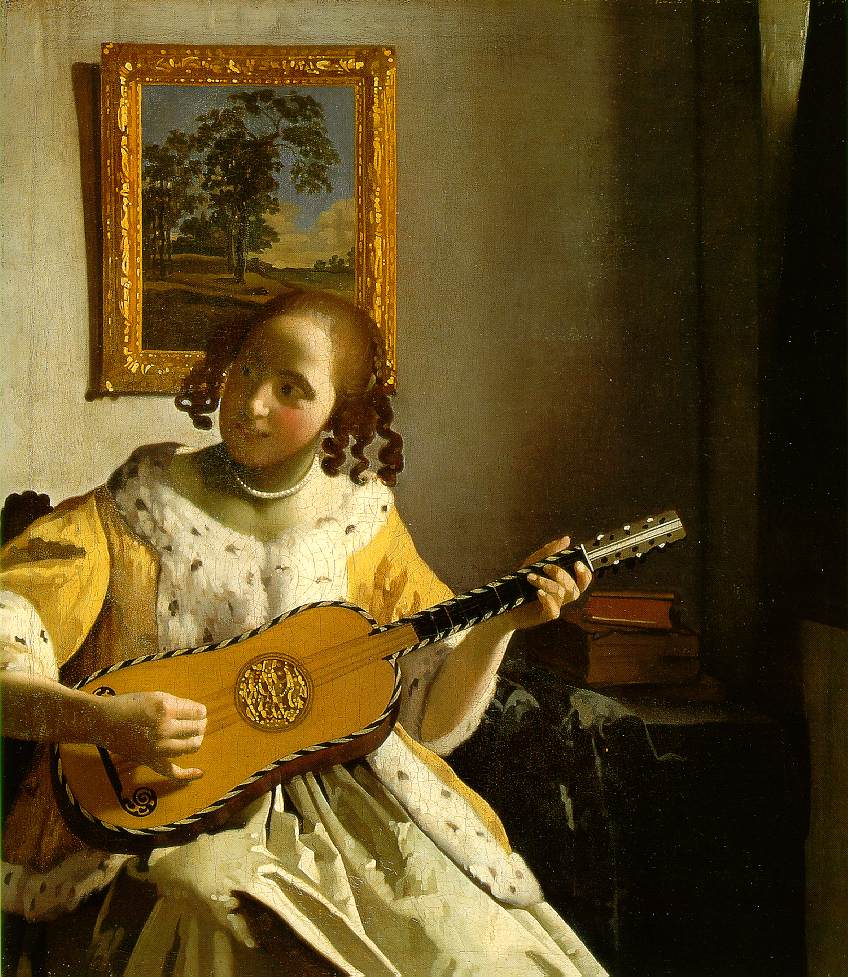
The Guitar Player 1672 hangs in the Kenwood English Heritage.

Kenwood English Heritage

. John Constable.
John Constable was born in 1776 -1887 in Suffolk. He is classed has an English Romantic painter.
His most famous paintings include Dedham Vale of 1802 and The Hay Wain of 1821. Although his paintings are now among the most popular and valuable in British art, he was never financially been successful He is known principally for his landscape painting of Dedham Valel, the area surrounding his home—now known as "Constable Country"—which he invested with an intensity of affection. "I should paint my own places best", he wrote to his friend John Fisher in 1821, "painting is but another word for feeling".www.nationalgallery.org.uk/paintings/john-constable-the-hay-wain
Contable married his childhood sweetheart Maria Bicknell , but she fell ill shortly after there seventh child at the age of 41. After her death according to a letter that constable wrote to his brother Golding " hourly do I feel the lose of my departed angel- god only knows how my children will be brought up- the face of the world is totally changed foe me".
.
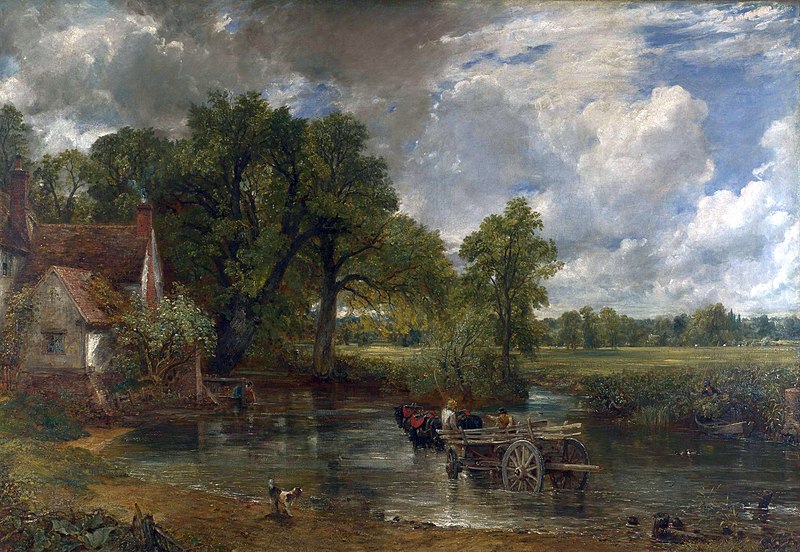
The Hay Wain 1826

The Corn Field : 1821
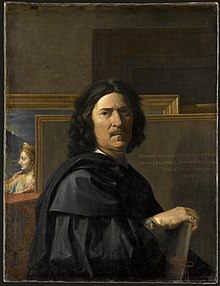
Nicolas Poussin was a French painter born in 1594- 1665, he came from a classicism Barogue movement. He was a major inspiration for other classical artists such as Jacques Louis David,Jean-Auguste- Dominique Ingres and Paul Cezanne.One of Poussin 's most famous oil painting on canvas was Et in Arcadia Ego ; 1637-38 which is located in Musee du Loure.

Et in Arcadia Ego

Jean - Louis Andre Theodore Gericault.
Gericault was a french artist born in 1791 -1824. He played a vital role in bridging Noe classical to romanticism.Gericault ia most famous work of art is 'The Raft of the Medusa. His later work was inspired by Dr Etienne -Jean Georget a pioneer in psychiatric medicine. Gericault painted a series of ten portraits of insane patients in exhibiting different afflictions, only five portraits remain including the painting ' Insane Women'. He also sketched severed heads and limbs. According to my research Gericault family had along history of insanity this did include Gericault , he also had mental health issues which reflected in his art
Gericault was a french artist born in 1791 -1824. He played a vital role in bridging Noe classical to romanticism.Gericault ia most famous work of art is 'The Raft of the Medusa. His later work was inspired by Dr Etienne -Jean Georget a pioneer in psychiatric medicine. Gericault painted a series of ten portraits of insane patients in exhibiting different afflictions, only five portraits remain including the painting ' Insane Women'. He also sketched severed heads and limbs. According to my research Gericault family had along history of insanity this did include Gericault , he also had mental health issues which reflected in his art
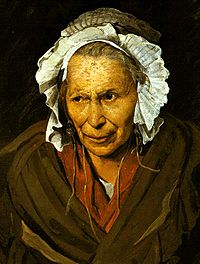
Insane Woman : 1822


The most reoccurring character in his artwork were horses, whom he also used symbolically to express his outlook on the world and its problems. The drawing above shows how horses play such an important role for portraying the mood in his work.drawingatduke.blogspot.com/2009/10/theodore-gericault.ht

Gericaul sketch work: severed head

This picture became a French icon of romanticism . Recordings state that on July 5th 1816 the captain whom had not sailed a ship for 25 years abandoned the ship when it started to sink off the coast of Mauritania, at least 147 people were left to drift after 13 days at sea , 15 died when when they were finally rescued . Gericault targeted well known tragedies to try and launch his own career into the public eye, by using is artist skills and a bit of public manipulation he just realised that the public are just a blank canvas just ready to be written on.


Oath of Horatii: 1784.
This oil painting by Jacques Louis David, which is located in the Louvre , Paris.This was a Roman legend about a dispute between two cities Rome and Albalong .Three brothers were prepared to give up there own life's for Roman.
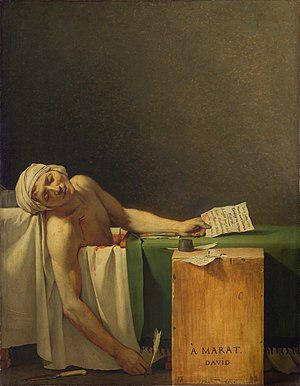
Dearth of Marat:1793.
This neo- classical style oil painting by Jacques Louis David is located in The Royal Museums of fine Arts of Belgium.. This is one of the most famous painting of the French Revolution, it is recorded that on 13th of July 1793 Charlotte Corday murdered Jean -Paul Marat.
.

Liberty Leading the People : 1830 Located in the Louvre.
Eugene Delacroix was born in 1798-1863. He was a French Romantic artist.He bridged neo- classical and romanticism. Delacroix expressive brushstrokes were for optimal effect of colour which pioneered the way for impressionists. Delacroix took his inspiration from ' Rubens' and painters of the venation Renaissance.Delacroix most famous canvas oil painting is ' Liberty Leading the People'.

Belshazzars feast (1635)
According to Daniel 5:1-31, King Belshazzars of Babylon takes sacred golden and silver vesselsfrom the Jewish Temple in Jerusalem by his predecessor Nebuchadnezzar. Using these holy items, the King and his court praise 'the gods of gold and silver, bronze, iron, wood, and stone'. Immediately, the disembodied fingers of a human hand appear and write on the wall of the royal palace the words MENE MENE, TEKEL, UPHARSIN

Rembrands
The Anatomy Lesson of Dr. Nicolas Tulp( 1632)
The Anatomy Lesson of Dr. Nicolas Tulp is located in the Mauritshuis Museum in The Hague , Netherlands. Anatomy was classed as a social event in the 17th century.Even they way they dressed suggests that it is a social occasion. The public and students had to pay a entry free and that body would have to be that of an executed criminal .
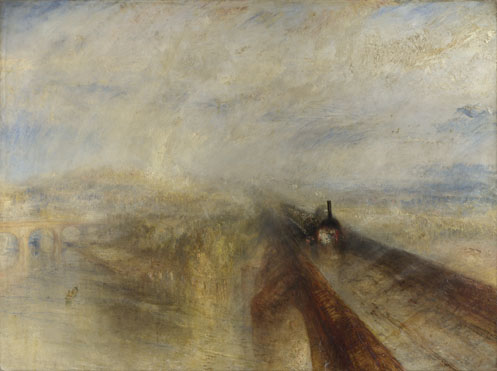
Joseph Turner , Rain, Steam, and Speed The Great Railway (1844).
Joseph Turner was an English Romantic and impressionist was born in 1775-1851. He well known for painting landscapes in oil and water colours .Rain,steam and speed The Great Western is an oil on canvas and is located in the National Gallery.

First Known Photo. (1826)
Joseph Niepe was a French inventor born in 1765-1833. His was the inventor of the photo above which took eight hours to expose ,so the sun had time to move from east to west,appearing to shine on both sides of the building and he also invented the world's first internal combustion engine.
Vincent Van Gogh was born in 1853-90 in the Netherlands. He belonged to the post- impressionist movement. H suffered from bouts of mental illness and died from a gunshot wound which is to believed that it was self inflicted. He was influenced by several artist e.g Anton Mauve ,Sean Francis Monticelli. Some of his most most famous works of art are ; the sunflower ,Bedroom in Aries, self Portrait. all on oil canvas
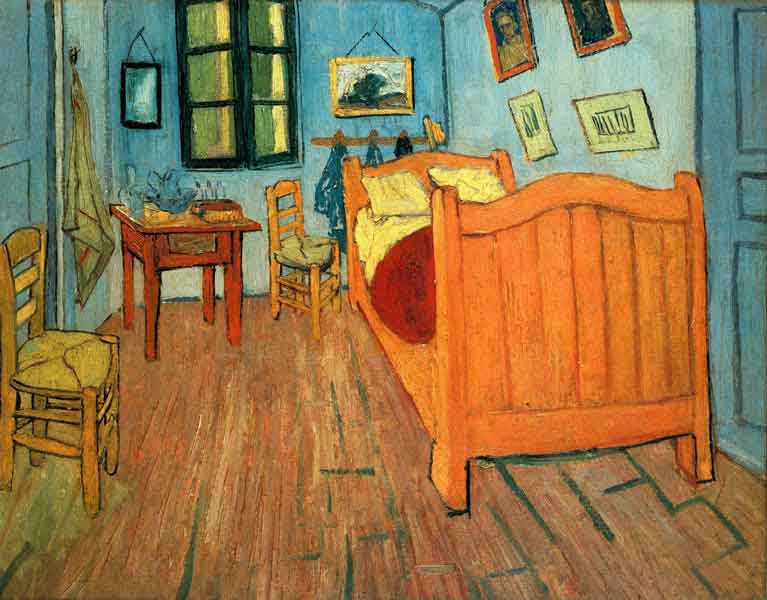
Bedroom in Aries (1888)
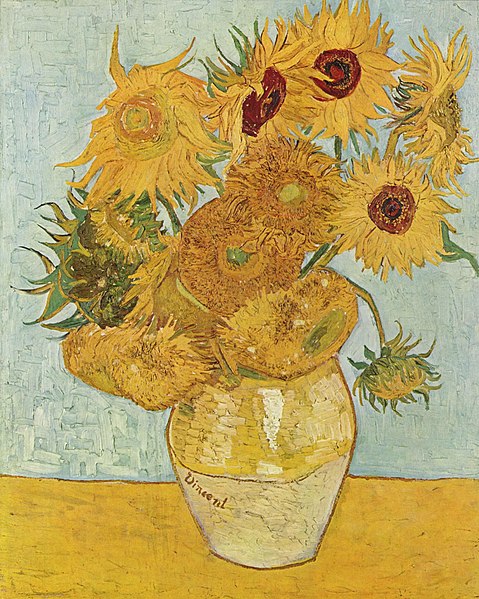
Still life: Vase with Twelve Sunflowers (1888)
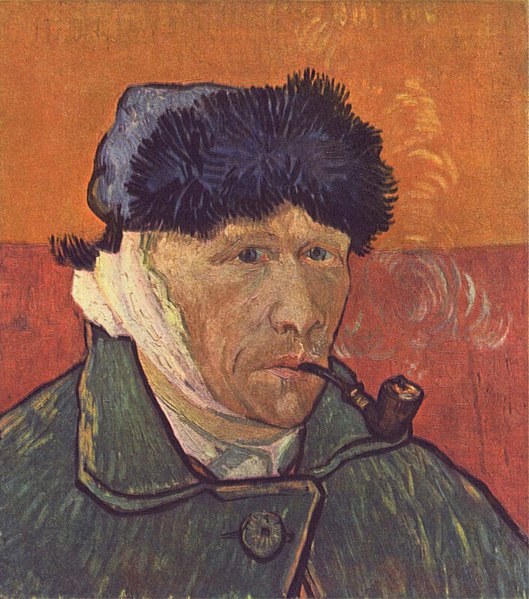
Self Portrait (1889)

Eugene Gaugin was a post impressionist artist and a sculptor born in 1848-1903 he was influenced by cloisonnist style which paved the way to primitivism and the return to the pastels colours.
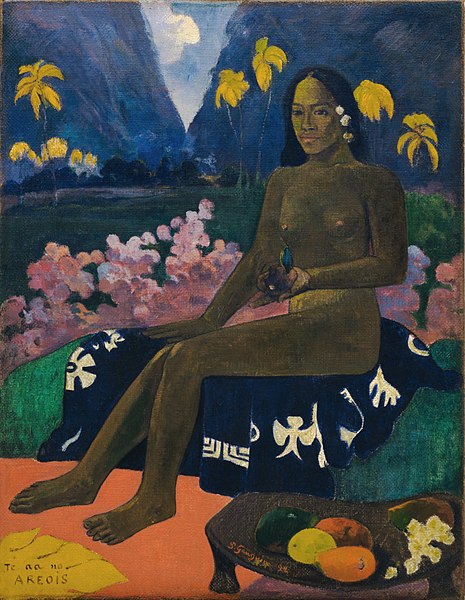
Seed of Area (1892) oil on Burlap

Cat
Edgar Degas was a french impressionist born in 1834-1917. He well known for his painting ,sculpture,printmaking and drawings. He was influenced by Mary Cassatt, Jean - Louis and Walter Sickert.
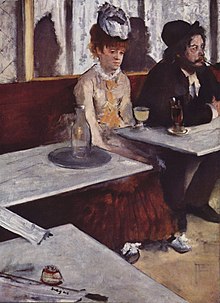
L'Absinthe (1876)

Ballet Rehearsal on stage (1874) on oil canvas

The Millinery Shop (1885) located in the Art Institute of Chicago.
Egon Schiele was an Austrian Expressionist born in 1890-1918, . He was well know for his Figurative paintings ,drawings and self portraits. His work was classed has erotic, pornographic, disturbing and focusing on sex, dearth and discovery.At first I did,t understand were he was coming from or what impression he was wanting to give use . ,but as I started to look at more of his sketching . I believe he was beyond his time in regards to his own sexuality even though he was married he still could of been gay or bi sexual and his art work was just his way of expressing his inner self.
In the autumn of 1918, the Spanish flu epidemic that claimed more than 20,000,000 lives in Europe reached Vienna. Edith, who was six months pregnant, succumbed to the disease on 28 October. Schiele died only three days after his wife. He was 28 years old. During the three days between their deaths, Schiele drew a few sketches of Edith; these were his last works.en.wikipedia.org/wiki/Egon_Schiele
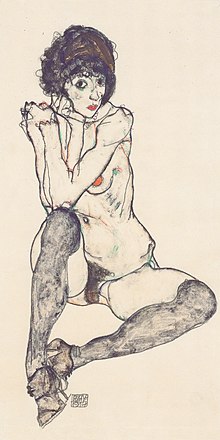
1914
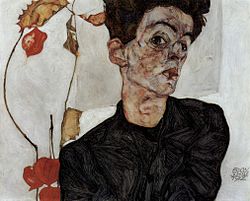
1912

1911

Two girls on a Fringed Blanket

Sexual act study
.jpg)
Embrace (The Loving)
Claude Monet was a French impressionist born in 1840-1926. He was well known for his charcoal caricatures, which he would sell for ten to twenty frans . It seems that he had many great mentors, Eugene, Boadin and than when the Franco - Prussion war broke out in1870 Monet fled to England where he was mentored by Constable and Turner, this is were its believed he got his inspiration from for his landscape paintings.
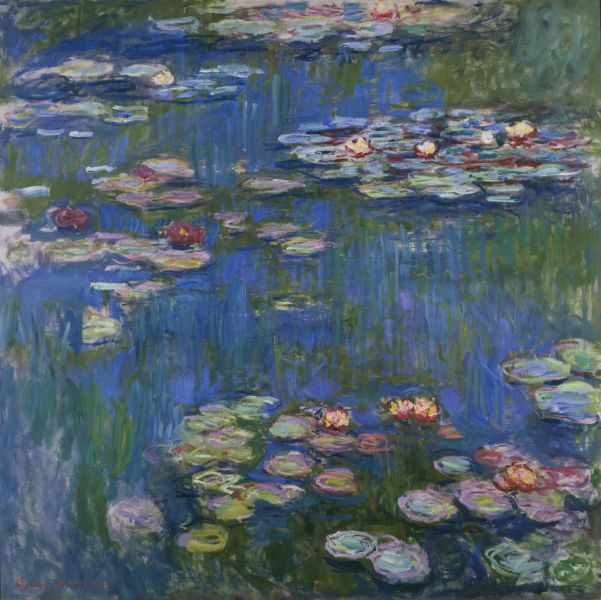
Water Lilies (1905) located in the National Museum of Western Art , Tokyo, : oil canvas

The Garden Flower (1900)

Wheatstacks (end of summer) 1897
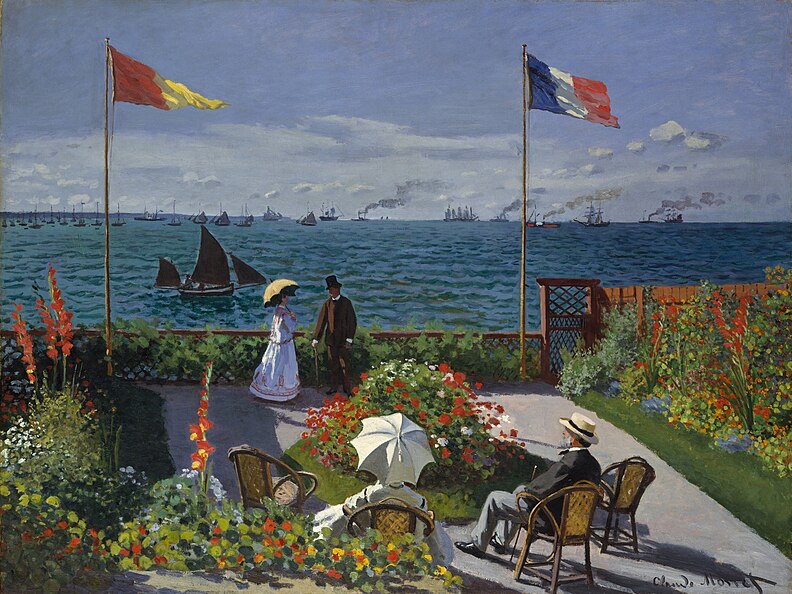
Francais (1866/7)
Paul Cezanne French post impressionist born in 1839 -1906
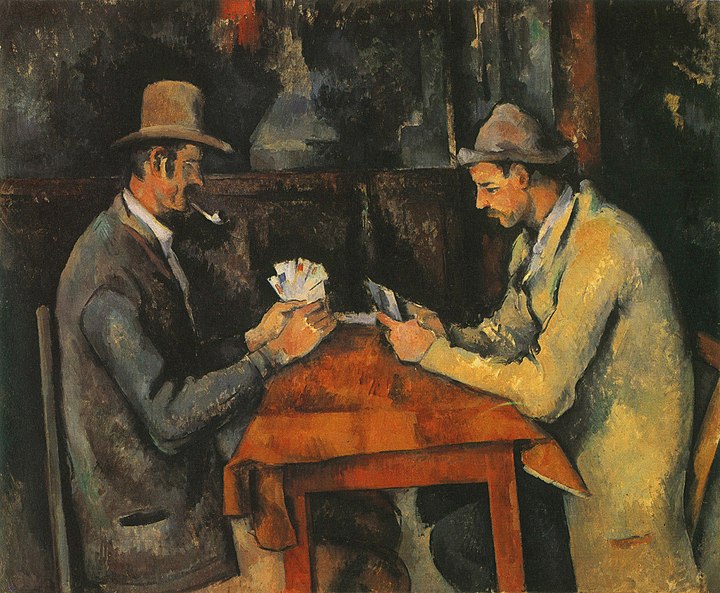
The Card Player (1892)

Rideau Cruchon et Compotier (1893-4) on oil canvas.
Gustav Klimt (1862-1918) was born in Vienna as the second child of Ernst and Anna Klimt. At the age of 15, he entered the Vienna Kunstgewerbeschule (1876-83). He was supposed to become a drawing teacher, but professor Ferdinand Laufberger recognized his talent. Klimt was influenced by Hans Makart and his teacher Julius Viktor Berger. In his early work from 1883 to 1892, Klimt was closely associated with his brother Ernst and with Franz Matsch. They created stage curtains, decorative wall and ceiling paintings, e.g. for the Burgtheater and the Kunsthistorisches Museum in Vienna. In 1893, Klimt began to work on his own. In 1897, Klimt was a cofounder and the first president of the "Vereinigung bildender Künstler Österreichs - Secession". Before the turn of the century, Klimt began to develop his distinctive neo-impressionist style. In 1899, he began to spend his summer holidays at lake Attersee every year, where he painted his most important sceneries. Around 1900, with his ornamented portraits of women, Klimt created a new type of picture. Women occupied the central place in his art. His portraits range from historicizing, to allegoric, mythological, erotic and classic. As with Judith I (see photograph below), women became icons. In 1900, a conflict about his works created for the University of Vienna made him largely leave the stage of public life and seek private customers. In 1907, the young Egon Schiele visited him for the first time in his atelier. A year later, Klimt held his protecting hands over Oskar Kokoschka and the expressionists, as, for the first time, they showed their works in Vienna. Klimt's late work showed abstract and expressionist elements. He died on February 6, 1918, at the age of 56.
en.wikipedia.org/wiki/The_Kiss_(Klimt_painting
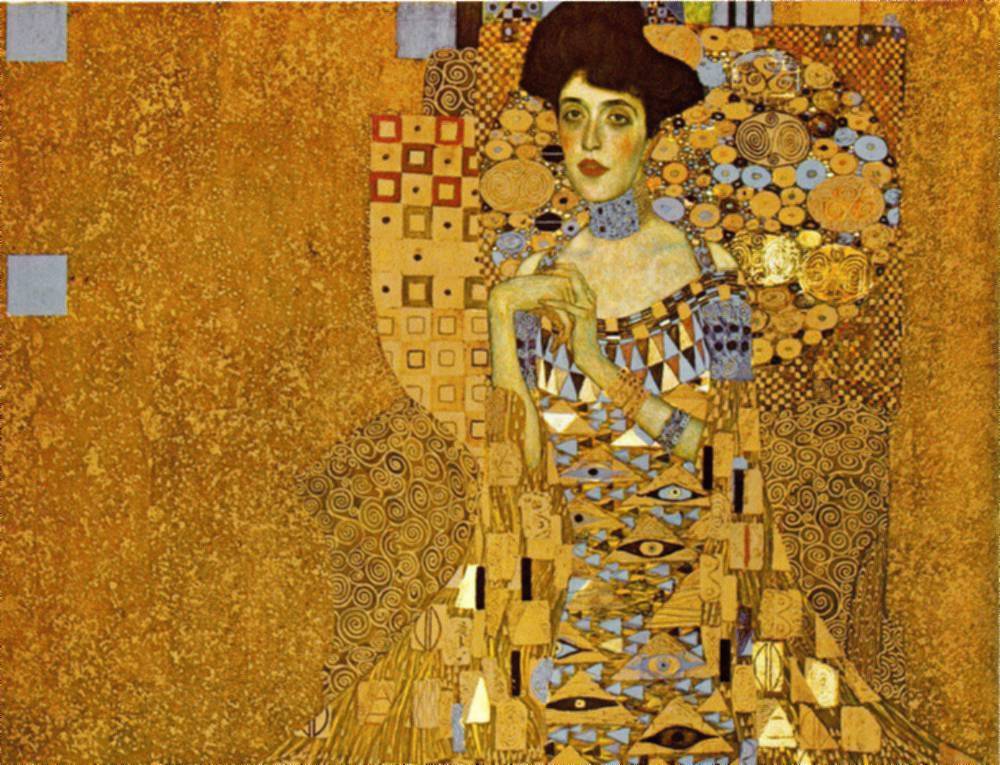
Adele bloch- bauert (1907) oil and gold on canvas

The Kiss. oil and gold leaf on canvas (1907-08)

Scream {1893)
Painted by Edward Munch on oil tempera and pastel on cardboard

John Stillmonks.com

John Stillmonk ; The Raven and the Pitcher. (2011)
This week we talked about the contextual lecture and the trip to Bradford museum. Katy set the class a small task within the class on how to research painters , we used the ( The Ralf of the Medusa) for the class example.
katy ask use to research Tom Hunter ,'Girl reading a repossession order', for next week so we could have a class debate which I will be looking forward to.
Week :5 3,11,2011
Bradford trip to Film National Media Television Radio Museum Web Photography.
We were asked by Katy to write up a review on to photographers Donovan Wylie and Daniel Meadows.
Donovan Wylie was given an opportunity by 'The Bradford Fellowship' to work alongside the Canadian forces in Afghanistan to produce a unique recording of life within the forces. The fellowship is a prestigious award given to mid- career photographers or artists to develop their professional practice in the context of the museum 's collection. Wylie had two displays one which was commission based which was a project to explore the functions of military architecture mainly 'watch towers' in Afghanistan (2010). All his prints were done by digital ink jet. The other prints were of 'The Maze prison ' in Northern Ireland, The Maze Prison contained radical political activists and it was designed to control, disorientate and diminish in-mates. I didn't really like the pictures from Afghanistan mainly because they were bleak and uninviting but his Maze picture were great and this is where his passion shows through for me, because its closer to home and it must touch a nerve or two and he can relate to the political side because as a child he grew up in a war zone.
Afghanistan (2010)
Maze Prison

Donovan Wylie: in mate cell at The Maze prison (2003).
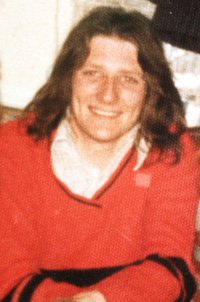
Bobby Sands
Bobby" Sands : 9 March 1954 – 5 May 1981) was an Irish volunteer of the Provisional Irish Republican Army and member of theUnited Kingdom Parliament who died on hunger strike while imprisoned in HM Prison Maze.
He was the leader of the 1981 hunger strike in which Irish republican prisoners protested against the removal of Special Category Status. During his strike he was elected as a member of the United Kingdom Parliament as an Anti H-Block/Armagh Political Prisoner candidate. His death resulted in a new surge of IRA recruitment and activity. International media coveragebrought attention to the hunger strikers, and the republican movement in general, attracting both praise and criticism.www.goodreads.com/author/show/230368.Bobby_Sands
DANIEL MEADOWS' work has been funded and supported by a partnership between the National Media Museum Fotogallery,Birmingham Central Libraries, Photography and the Archive Research Centre, University of the Arts London and Photoworks UK.Daniel was one of photographers who spearheaded the independent photography movement in the early 1970s breaking with tradition and infusing the medium with new energies and ways of seeing. Between 1971 and 1987, he produced an astonishing record of urban society in Britain working in a uniquely collaborative way through his interview with -and writing about- his subjects.
I really like Daniel Meadows' work compared to Donovan Wylie's work even though they are both commissioned based .You can feel that the passion in Meadows' work - it's about every day life and he has kept it real , even though the people in the pictures are somewhat staged, I love the fact that it's so natural and that there is a story in each picture .You can see this by just looking at their clothes , surroundings and their eyes.

Daniel Meadows touring bus 1973-74
links:
http://www.youtube.com/watch?v=2WFsiY2jHEo&feature=player_embedded
www.nationalmediamuseum.org.uk/donovanwylie.
Week : 6 7 ,11, 2011 tutor Chis Aughton.
This week Chris discussed art and design in the 19th and 20th century and that the 'March of Progress' were changing peoples out look within society, this included the first wave of feminist, Marxist, Karl Marc and how their views had an impact on how artist product their work . Art had changed to' applied art' meaning that is was more massed produced and that the general public could easily afford arts of work This was become it was more affordable compared only the very rich been only able to afford it . Painters like Blake and Raphael opposed change in society.Chris also discussed . Milbus/Rossetti/William Morrie/ Mackmurdowren/Art deco/ Art nouveau/Lugwig mie Van Der Rohe/Bauhaus building Peter Keler/ Rodchenkoplaket and Bronenosel.
William Blake was an English poet ,painter and printmaker, born in 1757-1827. He comes from the movement of visual art of the romantic age.It's believed that Blake had visions of seeing God from an early age this had an impact on his paintings. Blake was also a great advocate for 'free love movement.' He believed marriage was slavery and so he advocated for the removal of all state restriction sexual activity such as homosexuality and prostitution. Its seems than he was also s a pioneer for the liberal feminist movement.

` The Body Of Abel ;1825 : watercolour on wood.

This is the tittle page of the book 1790-1793.
Marriage of Heaven and Hell.
Raphael is an Italian painter and architect of the high renaissance movement, He was born in 1483-1520. At the age of eleven he was orphaned and went to lived with his uncle.In his later years he led a nomadic life.
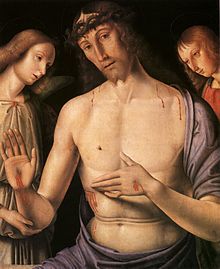
Giovani Sanli :1490

Raffaello Sposalizio :1504.
William Morris was an English textile designer ,artist,writer ,socialist, fantasy author/medievalist utopian theorist. Morris was associated with pre-RaphealiteBrotherhood and English arts and crafts movement.
His work is displayed in Wightwick Manor in the west Midlands also Morris's homes 'Red House' and' Kelmscott Manor' both these homes are owned by the Society of Antiquaries of London and is open to the public.
Most of his collection is held in The Art of South Australia which includes Morris and Co furnishings.
The Huntington Library Art Collections and Botanical Gardens in San Morina California has Morris collection of stained glass ,wallpaper,textiles, embroidery,drawings,ceramics , 2000 books and origanal woodblocks.

Morris tiles de Morgen:1876.

Morris snakeshead printed textile: 1872

David's charge to Soloman, by Burne - Jones and Morris ,Trinity, Church Boston Massachuetts :1882.

St George Cabinet :1861
made from mahogany ,pine and oak with copper mounts.
John Millous was an English man born in He was a painter and illustrator and was one of the founders of pre-Raphaelite brotherhood. This painting below was controversial, because of it realistic depiction of a young Jesus who had cut his hand on a nail , surround by dirty floors.

Christ in the house of his parents :1849-50
A.H. Mackmurdo was an English architect and designer born in 1851-1942

A.H. Mackmurdo.

A.H. Mackmurdo.
Art Nouveau.
Art Nouveau means new art and is classed has applied art especially the decorative arts. It became popular during 1890 till 1910. Art Nouveau was inspired by natural forms and structures such as flowers and plants .Architects were trying to combine natures natural lines and apply it to furniture and buildings. My research suggests that Czech artist Alphonse Mucha influenced this new style when he produced alithographed poster in 1895 in Paris.
Art Nouveau is a style of art its classed as applied art.

Staircase of the Madison and Atelier of Victor Horta.
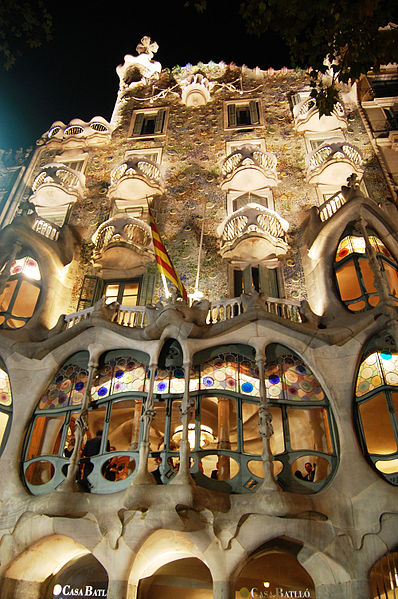
The Casa Batlio 1877.

Art Nouveau furniture.

Doorway in Paris.
Art Deco
The structure of Art Deco started in the 1920's and into the world war ll. Art Deco based on mathematical geometric shapes. It was widely considered to be an eclectic form of elegant and stylish modernism , being influenced by a variety of sources. The ability to travel and archaeological excavations during this time influenced artists and designers, integrating several elements from countries not their own. Among them were historical styles such as Greco-Roman classicism, as well as the art of
Babylon, Assyria,Ancient Egypt, Aztec, Mexico, and Africa.www.vam.ac.uk/page/a/art-deco/

The art Deco spire of the Chrysler building New York built 1928-30.

1934: Chrysler Airflow Sedan Carl Breer.

Art Deco furniture.


Art Deco bedroom.

Art demo bathroom.

Buffalo City Hall.:1894 designed by Louis Sullivan and Dankmar Adler.

Buffalo City Hall interior.

Bauhaus :1919 to 1930.
Bauhaus was a school in Germany that combined different types of crafts and fine art , founded by Walter Gropiais.

Buffalo City Hall
Peter Keler, born in Kiel in 1898, was an extremely versatile artist from the generation of Bauhaus students, with skills in painting, furniture design, graphic art, architecture and interior design.
Peter keler was working as a trainee at the Kiel School of Applied Arts when World War I broke out and was drafted in 1917. He continued his training in Kiel after the end of the war, but now he was also taught carpentry. He enrolled at the Weimar Bauhaus in 1921, where he took the preparatory course with Johannes Itten and also mural painting with Schlemmer and Kandinsky. He had the opportunity to put theory into practice in the design of the offices of the "Faguswerk" in Alfeld, aproject led by Walter Gropius.He executed first furniture designs for the 1923 Bauhaus exhibition, among them his most acknowledged work, a cradle of geometric bodies painted in the fundamental colors (1922). This work, consisting of a blue circle, a yellow triangle and a red square, is proof of the enormous influence of the color theories of his teacher Wassily Kandinsky. The "Rote Kubus" (Red Cube) also counts among the important pieces of furniture from his Bauhaus years, a chair in an austere design that was made in 1925 and is also known as "D 1". The company
www.ketlerekunst.com/bio/peter-keler1898shtml.
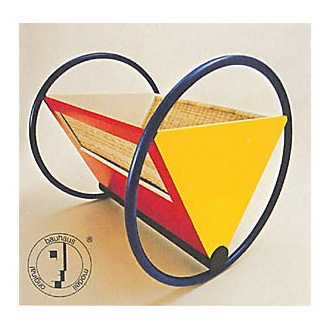
Peter Keler

Peter Keler
Lugwig Mie Van Der Roho an architect born in Germany in 1886 - 1969.He was regarded as the pioneering master of modern architecture. His buildings where designed with minimalist structure and open planning. His famous quote is' Less is more'

Lake Shore Drive, Chicago 1949-51

Martin Luther JR Memorial Library Washington.
This a modern building in London but it is very similar to Ludwig.s work.Less structure ,more glass and simply lines.
De Stijl , Dutch for' The Style' also known as neoplasticism.
Ther was a Dutch artistic movement founded in 1917. They sought to express a new utopian ideal of spiritual harmony and order. They only used simplified visual compositions to vertical and horizontal directions only using primary colours along with black and white.
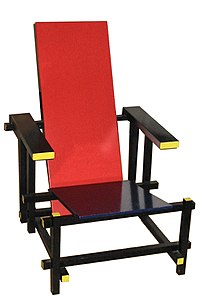
Red and Black chair designed by Gerrit Rielveld in1917.

Compostion with yellow ,blue and red: 1937-42. by Piet Mondrian , on oil canvas , located in the Tate Gallery
El Lissitzky was born in 1890 -1941 in Russia , he was a artist, designer, photographer, typographer, and architect . He was influenced by the Bauhaus and the constructivist movement.

Cloud Iron.
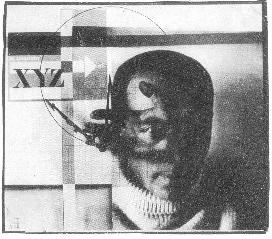
Laszlo Moholy Nagy was born in 1895-1946. He was a Hungarian painter and photographer as well as a professor in the Bauhaus school. He was influenced by constructivism.

El Lissitzky.

El Lissitzky.
British Arist
The training of artists, which had long been weak, began to be improved by private and government initiatives in the 18th century, and greatly expanded in the 19th, and public exhibitions and later the opening of museums brought art to a wider public, especially in London. In the 19th century publicly displayed religious art once again became popular, after a virtual absence since the Reformation, and, as in other countries, movements such as the Pre- Raphaelite Brotherhood and the Glasgow School contended with established Academic art. The British contribution to early Modernist art was relatively small, but since World War II British artists have made a considerable impact on Contemporary art , especially with figurative work, and Britain remains a key centre of an increasingly globalized art world.www.antonygormley.com

The Angel of the North , near Gateshead by Antony Gormley 1998.

By Antony Gormley Another place where 100 cast iron figures face out to Sea on Crosby beach near Liverpool.
Critical studies seminar Katy 6 :week
This week we had our first student meeting were we all had a chance to air our views. We also discussed Tom Hunter - Girl Reading a repossession order.
week: 7 14,11,11
Contexual studies.
This week Chris talk about that appled art had a particular use and it had a purpose.He also talked about figutive art and that is really dident have a use.Chris mainly talked about Cubism which I did struggle to understand what the the use of abtract art was for. The artist we spoke about werte.Kandinsky/Modrian/ Paul Klep/Braque/Duchamp/Mutt.
www.cubism-asada.com/what_cubism.html
In the first stage of Analytic and Synthetic Cubism, Picasso and Braque showed evidence of geometrical forms in Picasso’s “The Three Women” (1908-1909) and “Female Nude” (1910) and Braque’s “Houses and Trees” (1908). Cubist paintings break up figures on canvas, which lends them more depth and life on a two-dimensional surface. Art history lovers can also find written notes by Braque, his aphorisms or expressions of love on the subject of art. These writings were first published in 1917, and they reveal his thinking as a Cubist. For example, Braque wrote, “To be pure imitation, painting must make an abstraction from appearances.”
The second stage of Cubism called Orphic Cubism was a side journey from Picasso and Braque. Notable artists were Robert Delaunay, Sonia Delaunay-Terk, Marcel Duchamp, Fernand Leger, and Francis Picabia. Paintings which exemplified this branch of Cubism are Sonia Delaunay’s “Simultaneous Contrasts,” and Robert Delaunay’s “Circular Forms,” and Leger’s “Contrast of Forms.” Duchamp and Picabia would soon become key members of the Dada movement; however, Dadaism focused heavily on multiple art forms, including stream-of-consciousness writing and publication and radical performance art.
In 1911, an assortment of artists displayed their works in a Paris exhibit. Written accounts of these works labeled them as the first “Cubists” even after Braque and Picasso had already created several Cubist works. In 1912, other Cubist exhibitions swept Europe, but Braque and Picasso did not participate. Two artists, Albert Gleizes and Jean Metzinger, even published “Du Cubisme,” a book on the subject. Although Picasso’s work spanned almost a century, when people think of Picasso they often conjure up an image of one of his renowned Cubist paintings. http://www.arthistory.ne/
Kandinsky was born in Russian in 1866-1944. he came from the expressionism and abstract art moverment. He was fascinated with colour symbolism and psychlogy as he grow up as a child.

Der Blaue Reiter(1903)

Munich-Schwabing,with the Church of ST Ursula
(1908)

Kandinsky: Love me same

COMPOSITION XI (1939)
Piet Mondrian was a Dutch oainter born in 1872-1944. He came from the De Stijl movement. He was deeply influenced by Pable Picasso Georges Braque and Theo Van Doesburg.
In the early paintings of this style the lines delineating the rectangular forms are relatively thin, and they are gray, not black. The lines also tend to fade as they approach the edge of the painting, rather than stopping abruptly. The forms themselves, smaller and more numerous than in later paintings, are filled with primary colors, black, or gray, and nearly all of them are colored; only a few are left white.
During late 1920 and 1921, Mondrian's paintings arrive at what is to casual observers their definitive and mature form. Thick black lines now separate the forms, which are larger and fewer in number, and more of them are left white than was previously the case. This was not the culmination of his artistic evolution, however. Although the refinements became more subtle, Mondrian's work continued to evolve during his years in Paris.
In the 1921 paintings, many of the black lines (but not all of them) stop short at a seemingly arbitrary distance from the edge of the canvas, although the divisions between the rectangular forms remain intact. Here too, the rectangular forms remain mostly colored. As the years passed and Mondrian's work evolved further, he began extending all of the lines to the edges of the canvas and he also began to use fewer and fewer colored forms, favoring white instead.
en.wikipedia.org/wiki/Piet_Mondrian

Grey Tree (1912)


Composition Vii Piet Mondrian China.: oil painting

Comostion with large Blue plane ,Red, Black, Yellow and Gray :1921- oil painting on canvas .Located in the Dallas Museum of Art.
Paul Klee was born in Münchenbuchsee, Switzerland, and is considered both a German and a Swiss painter . His highly individual style was influenced by movements in art that included expressionism . He was, as well, a student of orientalism. Klee was a natural draftsman who experimented with and eventually mastered color theory, and wrote extensively about it; his lectures Writings on Form and Design Theory (Schriften zur Form und Gestaltungslehre), published in English as the Paul Klee Notebooks
Painting is the practice of applying paint, pigment, color or other medium to a surface . The application of the medium is commonly applied to the base with a brush but other objects can be used. In art, the term painting describes both the act and the result of the action...
Expressionism was a modernist movement, initially in poetry and painting, originating in Germany at the beginning of the 20th century. Its typical trait is to present the world solely from a subjective perspective, distorting it radically for emotional effect in order to evoke moods or ideas...
Surrealism is a cultural movement that began in the early 1920s, and is best known for the visual artworks and writings of the group members....
 In the visual arts, color theory is a body of practical guidance to color mixing and the visual impacts of specific color combinations. Although color theory principles first appeared in the writings of Leone Battista Alberti and the notebooks of Leonardo da Vinci , a tradition of "colory theory"...
Painting
Expressionism
Orientalism
Orientalism is a term used for the imitation or depiction of aspects of Eastern cultures in the West by writers, designers and artists, as well as having other meanings...
Color theory

Crystal Gradition :Klee.

Red Ballon :1922 on muslin primed with chalk, located in Soloman R. Guggenheim Museum, New York.

Tala ala Hoffmann: 1921 Water colourand pencil on paper. loacated in the Metropolition Museum of Art. in New York...
Pablo Picasso was a born in 1881 -1973 in Spain.He was a painter, sculptor, printer,ceramicist and stage designer . He was a co-founder of cubist movement. Picasso was influenced by what was going on around him which reflected in his works of art. This included his blue, red , African period ,cubism, Classicism and surrealism.

Portrait of David Henry Kahnweiler: 1910.oil on canvas.
Located in the Art Institute of Chicago.

La Vie : 1903, located in Cleveland Museum of Art.(blue period)

Child with Dove : 1901

Gargon a la pip : 1905 (red period)

Les Demoiselles D'Avignon ;1907. (African period)
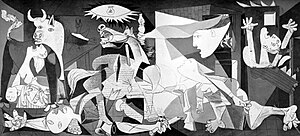
Guernica : 1937, oil on canvas.
Pablo Picasso’s most famous work is his depiction of the German Bombing of Guermica during the Spanish Civil War. This large canvas embodies for many the inhumanity, brutality and hopelessness of war. Asked to explain its symbolism, Picasso said, “It isn’t up to the painter to define the symbols. Otherwise it would be better if he wrote them out in so many words! The public who look at the picture must interpret the symbols as they understand them.
Guernica hung in New York’s Museum of Modern Art for many years. In 1981Guernica was returned to Spain and exhibited at the Cason del Buen Retiro. In 1992 the painting hung in Madrid’s Reina Sofia Museum when it opened.
www.picasso.com
George Braque was born in1882-1963. He was a French painter, drawer, sculpture and printmaker and came from the cubism and fauvism movement.

The Estaque :1906.

Violin and Candlestick : 1910. ,Located in San Francisco Museum of Modern Art.
Marcel Duchamp was born in 1887-1968. He was a French artist , sculpture ,His work was a associated with the Dadiast and surrealist movement.
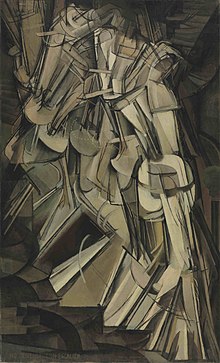
Nude Descending a Staircase no.2 :1912 , oil on canvas.
Located in Philadelphia Museum of Art.
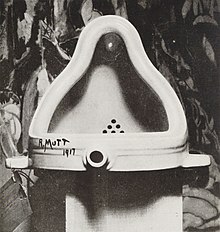
Fountain : 1917.
The most prominent example of Duchamp's association with Dada was his submission of Fountain a urinal, to the Society of Independent Artists exhibit in 1917. Artworks in the Independent Artists shows were not selected by jury, and all pieces submitted were displayed. However, the show committee insisted that Fountain was not art, and rejected it from the show. This caused an uproar amongst the Dadaists, and led Duchamp to resign from the board of the Independent Artists. www,duchamp.com.
WEEK : 8 21,11,11
This week Chris discussed about surrealism , Freud on Dream theories , ID - ego and super ego, UnChien , Tangy , Rimbaual and Baudelaire the poets. The class watched videos which were not nice to watch and we did some drawings which was fun.
Surrealist works feature the element of surprise, unexpected juxtapositions and non sequitur ; however, many Surrealist artists and writers regard their work as an expression of the philosophical movement first and foremost, with the works being an artifact. Leader Andre Breton was explicit in his assertion that Surrealism was above all a revolutionary movement.
Surrealism developed out of theDada activities during World War l and the most important centre of the movement was Paris. From the 1920s onward, the movement spread around the globe, eventually affecting thevisual arts, literature, film and music of many countries and languages, as well as political thought and practice,philosophy andsocial theory .
As they developed their philosophy, they believed that Surrealism would advocate the idea that ordinary and depictive expressions are vital and important, but that the sense of their arrangement must be open to the full range of imagination according to the Hegelian Dialectic. They also looked to the Marxist Dialectic and the work of such theorists as Walter Benjamin and Herbert Marcuse.
Freud's work with free association, dream analysis, and the unconscious was of utmost importance to the Surrealists in developing methods to liberate imagination. They embraced idiosyncrasy , while rejecting the idea of an underlying madness. Later, Salvador Dali explained it as: "There is only one difference between a madman and me. I am not mad."
Beside the use of dream analysis, they emphasized that "one could combine inside the same frame, elements not normally found together to produce illogical and startling effects." Breton included the idea of the startling juxtapositions in his 1924 manifesto, taking it in turn from a 1918 essay by poet Pierre Reverdy, which said: "a juxtaposition of two more or less distant realities. The more the relationship between the two juxtaposed realities is distant and true, the stronger the image will be -- the greater its emotional power and poetic reality.".
The group aimed to revolutionize human experience, in its personal, cultural, social, and political aspects. They wanted to free people from false rationality, and restrictive customs and structures. Breton proclaimed that the true aim of Surrealism was "long live the social revolution, and it alone!" To this goal, at various times Surrealists aligned with communism and anarchism.
Surrealist Manifesto
In 1924 they declared their philosophy in the first "Surrealist Manifesto".
Breton wrote the manifesto of 1924 that defines the purposes of the group. He included citations of the influences on Surrealism, examples of Surrealist works and discussion of Surrealist automatism. en.wikipedia.org/wiki/Surrealism
Sigmund Freud
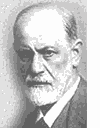 Considered the father of psychoanalysis, Sigmund Freud (1856-1939) revolutionizes the study of dreams with his work The Interpretation Of Dreams. Freud begins to analyze dreams in order to understand aspects of personality as they relate to pathology. He believes that nothing you do occurs by chance; every action and thought is motivated by your unconscious atsome level. In order to live in a civilized society, you have a tendency to hold back our urges and repress our impulses. However, these urges and impulses must be released in some way; they have a way of coming to the surface in disguised forms.
One way these urges and impulses are released is through your dreams. Because the content of the unconscious may be extremely disturbing or harmful, Freud believes that the unconscious expresses itself in a symbolic language.
Freud categorizes aspects of the mind into three parts:
Id - centered around primal impulses, pleasures, desires, unchecked urges and wish fulfillment.
Ego - concerned with the conscious, the rational, the moral and the self-aware aspect of the mind.
Superego - the censor for the id, which is also responsible for enforcing the moral codes of the ego.
When you are awake, the impulses and desires of the id are suppressed by the superego. Through dreams, you are able to get a glimpse into your unconscious or the id. Because your guards are down during the dream state, your unconscious has the opportunity to act out and express the hidden desires of the id. However, the desires of the id can, at times, be so disturbing and even psychologically harmful that a "censor" comes into play and translates the id's disturbing content into a more acceptable symbolic form. This helps to preserve sleep and prevent you from waking up shocked at the images. As a result, confusing and cryptic dream images occur.
According to Freud, the reason you struggle to remember your dreams, is because the superego is at work. It is doing its job by protecting the conscious mind from the disturbing images and desires conjured by the unconscious. www.dreammoods.com

Yves Tanguy, Indefinite :1942,
located in the Albright Knox Art Gallery, New York.

Salvador Dali ;The Persistence of Memory : 1931. Located in Museum of Mordern Art.

There is a cut to a close-up of a young woman (Simone Mareuil) being held by the man as she calmly stares straight ahead. Another cut occurs to the moon being overcome by the cloud as the man slits the woman's eye with the razor, and thevitreous humour spills out from it.en.wikipedia.org/wiki/Un_Chien_Andalou.
WEEK : 9
This week Chris talked about American abstract expressionism , fieldism and hyper-realism . I have never heard of these movements long with surrealism and cubism .I find this five movements hard to understand. We discussed Cornell / Hopper /Pollark / Rothko / Newman / Goldworthy / Magenta / Peter Blake/ Hamilton / Smith / Warhol / Benamin / Riley and Andra.
Edward Hopper was was an American realist painter and printer born 1882 1967. Hopper was best known for his Urban and rural scenes. He captured reflections of modern American life though painting.


Summer interior :1909.

New York Restaurant :1922.

Girl at Sewing Machine : 1921.
Joseph Cornell was An American artist, sculptor and film maker born in 1903 -1972. Cornell also pioneered the way for the assemblage movement, influenced by surrealism.

Untitied (Dieppe) 1958,
Located in the Museum of Modern Art in New York City.

 COCKATOO.
Jackson Pollark was an American painter of abstract expressionist movement ,born in 1912-1956. He struggled with alcoholism most of his adult life. Pollark died in an alcoholic related car accident.
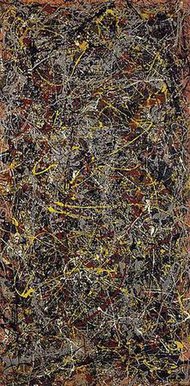
No 5 : 1948.
Mark Rothko was a Russian born American painter of abstract expressionist, born in 1903-1970.
 No3, No 13 (magennta, black, green on
orange . : 1948.
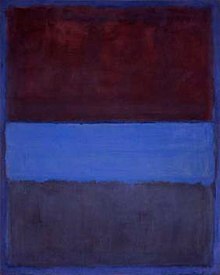
Rust and Blue ;1953.
Barnett Newman was an American Abstract expressionist , born in 1905 - 1970. He came from a family of Jewish immigrants from Poland.

Onement 1: 1948
 Who's Afraid of Red, Yellow and Blue :1966.
Sir Peter Thomas Blake, (born 25 June 1932) is an English pop artist Best known for his design of the sleeve for the Beatles album Sgt Pepper Lonely Hearts Club Band. He lives in Chiswick London, UK.
During the late 1950s, Blake became one of the best known British pop artists. His paintings from this time included imagery from advertisements,music hall entertainment, and wrestlers, often including collaged elements. Blake was included in group exhibitions at the Institute of Contemporary Arts and had his first solo exhibition in 1960. It was with the 'Young Contemporaries' exhibition of 1961 where he was exhibited alongsideDavid Hockney and R.B. Kitaj that he was first identified with the emerging British Pop Art movement. Blake won the (1961) John Moores junior award for his work Self Portrait with Badges. He first came to wider public attention when, along with Pauline Boty, Derek Boshier and Peter Phillips, he was featured in Ken Russell's Monitor film on pop art, Pop Goes theEasel, which was broadcast on BBC television in 1962. From 1963 Blake was represented by Robert Fraser which placed him at the centre o fswinging London and brought him into contact with leading figures of popular culture.wwwpeterblake.com.
 Self portrait : 2007.

On the Balcony:1955-57 . Located in the Tate Gallery.
Richard Hamilton is a British artist born in 1922 - 2011. Hamilton came from the pop art movement.
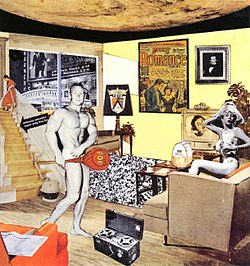
Just what is it that makes today's homes so different, so appealing.
Andrew Warhol (August 6, 1928 – February 22, 1987), known as Andy Warhol, was an American painter , printmaker, and filmmaker who was a leading figure in the visual art movement known as pop art . After a successful career as a commercial illustrator,.Warhol became famous worldwide for his work as a painter,avant grade film maker, record producer, author, and member of highly diverse social circles that included Bohemiant street people, distinguished intellectuals, Hollywood celebrities and wealthy patrons.
On June 3, 1968, Valerie Solanas shot Warhol as well as art critic and curator Mario Amaya at Warhol's studio.Before the shooting, Solanas had been a marginal figure in the Factory scene. She authored the S.C.U.M. Manifesto,a separatist feminist attack on males. Solanas appears in the 1968 Warhol film I, a Man. Earlier on the day of the attack, Solanas had been turned away from the Factory after asking for the return of a script she had given to Warhol. The script, apparently, had been misplaced. www.andywarhol.org.
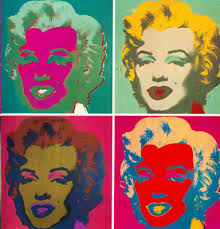
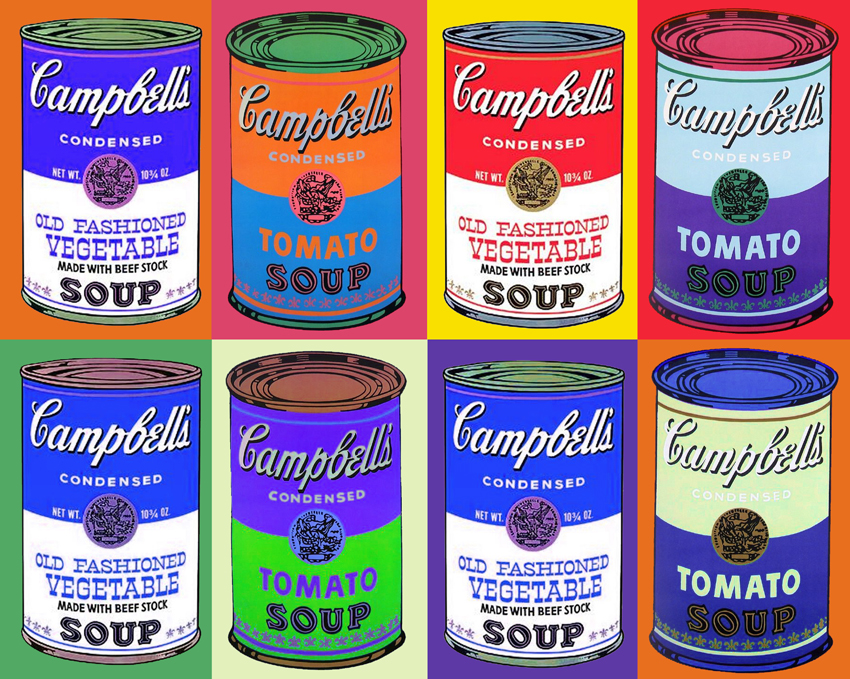
1960.
Bridget Louise Riley is an English painter born in 1931. Riley came from the optical art movement.
 Movement in Squares : 1961.
 Shadow Play :1990.
Roy Lichtenstein (October 27, 1923 – September 29, 1997) was a prominent American pop artist. During the 1960s his paintings were exhibited at the Leo Castelli Gallery in New York City and along with Andy Warhol, Jasper Johns, James Rosenquist and others he became a leading figure in the new art movement. His work defined the basic premise of pop art better than any other through parody. Favoring the old-fashioned comic strip as subject matter,Lichtenstein produced hard-edged, precise compositions that documented while it parodied often in a tongue-in-cheek humorous manner. His work was heavily influenced by both popular advertising and the comic book style. He himself described Pop Art as, "not 'American' painting but actually industrial painting".n.wikipedia.org/wiki/Roy_Lichtenstein

Drowning Girl : 1963.on canvas.
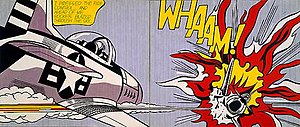
Whaam 1963 , on canvas.
 The Head :1992, Barcelona.
Carl Andre (born September 16, 1935) is an American minimalist artist recognised for his ordered linear format and grid format sculptures. His sculptures range from large public artworks (such as Stone Field Sculpture, 1977 in Hartford and Lament for the Children, 1976n Long Island City, NY) to more intimate tile patterns arranged on the floor of an exhibition space (such as 144 Lead Square, 1969 orTwenty-fifth Steel Cardinal, 1974). In 1988, Andre was tried and acquitted for murdering his wife, artist Ana Mendieta..www.carlandra.com.


Lucas Sarah came from the Young British artist movement . Sarah was included in the 198 group exhibition called ' Freeze' withe contemporaries, Angu Fairhurst, Damien Hirst and Gary Hume and Tracey Ermin.
In the early 1990s, Lucas began using furniture as a substitute for the human body. Through her career, Lucas has continued to appropriate everyday materials (including, for example, freshly made fried eggs) to make works that use humour, visual puns and sexual metaphors of sex, death, Englishness and gender.www.lucas sarah.com

self portrait.
Tracey Emin is an a British artist born in 1963 and came from the Young British Artist movement. Tracey Ermin is better known for her exhibitions of 'Everyone I ever Slept with' and My Bed. In 2004 her work was destroyed in a Momart warehouse fire.
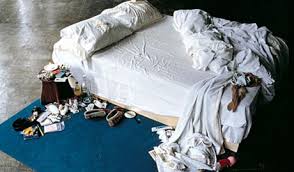 Tracey Emin : My Bed. ; 1999.

Tracey Ermin : Everyone I ever slept with

Tracey Ermin :2001
Jeff Koons is an American Artist born in1955. known for his reproduction of banal objects. Critics are divided , some believes his work is pioneering and is a major historical importance.

Jeff Koons ;Ballon Flower :2006
Damien Hirst was born in England in 1965 and belonged to the Young British Artist movement. He is British Richest living famous artist.

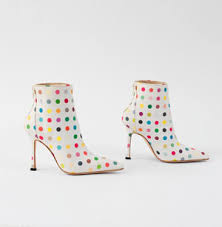
Rob Muek is an Hyper realist sculptor . he began his career on Australian children's televisin program. Mueck was a model maker and puppeteer.. Mueck established his own company in London , making photo realistic props and animatronic for the advertising industry.
 MASK II (201 - 2002)

In Bed :2005
week: 11
This week Chris talked about photographery and how " how a camera ever lies" , negatives and postive images. How a a image is a different comparison compared to painting. Its more of a recording of life ,history, it makes people think. We talked about Niepce, Daguerre, Henry Fox Talbot,William Henry, Blossfeild, Julien Cameron, Capas barconnormandia, Cunningham, Adam Aspens, Roger Fenton, Edward Weston, Dorothy Lang, Rodchenko Salgado.
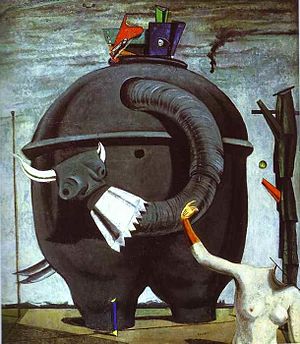
Max Ernst ,The Elephant Celebes :1921, Located in the Tate , London.
The film has no plot in the conventional sense of the word. The chronology of the film is disjointed, jumping from the initial "once upon a time" to "eight years later" without the events or characters changing very much. It usesdream logic in narrative flow that can be described in terms of then-popular Freudian free association, presenting a series of tenuously related scenes.
The film has no plot in the conventional sense of the word. The chronology of the film is disjointed, jumping from the initial "once upon a time" to "eight years later" without the events or characters changing very much. It usesdream logic in narrative flow that can be described in terms of then-popular Freudian free association, presenting a series of tenuously related scenes.
There is a cut to a close-up of a young woman (Simone Mareuil) being held by the man as she calmly stares straight ahead. Another cut occurs to the moon being overcome by the cloud as the man slits the woman's eye with the razor, and thevitreous humour spills out from it.en.wikipedia.org/wiki/Un_Chien_Andalou.
WEEK : 9
This week Chris talked about American abstract expressionism , fieldism and hyper-realism . I have never heard of these movements long with surrealism and cubism .I find this five movements hard to understand. We discussed Cornell / Hopper /Pollark / Rothko / Newman / Goldworthy / Magenta / Peter Blake/ Hamilton / Smith / Warhol / Benamin / Riley and Andra.
Abstract expressionism was an American post–World War II art movement. It was the first specifically American movement to achieve worldwide influence and put New York City at the centre of the western art world, a role formerly filled by Paris. Although the term "abstract expressionism" was first applied to American art in 1946 by the art critic Robert Coates, it had been first used in Germany in 1919 in the magazine Der Sturm, regarding German Expressionism. In the USA, Alfred Barr was the first to use this term in 1929 in relation to works by Wassily Kandinsky.[1]
The movement's name is derived from the combination of the emotional intensity and self-denial of the German Expressionists with the anti-figurative aesthetic of the European abstract schools such as Futurism, the Bauhaus and Synthetic Cubism. Additionally, it has an image of being rebellious, anarchic, highly idiosyncratic and, some feel, nihilistic.(www.americanabstractexpressionism.org)
Edward Hopper was was an American realist painter and printer born 1882 1967. Hopper was best known for his Urban and rural scenes. He captured reflections of modern American life though painting.

Hopper : 1942 Nighthawks, Located in Art Insitute of Chicogo
Summer interior :1909.
New York Restaurant :1922.
Girl at Sewing Machine : 1921.
Joseph Cornell was An American artist, sculptor and film maker born in 1903 -1972. Cornell also pioneered the way for the assemblage movement, influenced by surrealism.
Untitied (Dieppe) 1958,
Located in the Museum of Modern Art in New York City.
MEDICI BOY.
Jackson Pollark was an American painter of abstract expressionist movement ,born in 1912-1956. He struggled with alcoholism most of his adult life. Pollark died in an alcoholic related car accident.
No 5 : 1948.
Mark Rothko was a Russian born American painter of abstract expressionist, born in 1903-1970.
orange . : 1948.
Rust and Blue ;1953.
Barnett Newman was an American Abstract expressionist , born in 1905 - 1970. He came from a family of Jewish immigrants from Poland.
Onement 1: 1948
Sir Peter Thomas Blake, (born 25 June 1932) is an English pop artist Best known for his design of the sleeve for the Beatles album Sgt Pepper Lonely Hearts Club Band. He lives in Chiswick London, UK.
During the late 1950s, Blake became one of the best known British pop artists. His paintings from this time included imagery from advertisements,music hall entertainment, and wrestlers, often including collaged elements. Blake was included in group exhibitions at the Institute of Contemporary Arts and had his first solo exhibition in 1960. It was with the 'Young Contemporaries' exhibition of 1961 where he was exhibited alongsideDavid Hockney and R.B. Kitaj that he was first identified with the emerging British Pop Art movement. Blake won the (1961) John Moores junior award for his work Self Portrait with Badges. He first came to wider public attention when, along with Pauline Boty, Derek Boshier and Peter Phillips, he was featured in Ken Russell's Monitor film on pop art, Pop Goes theEasel, which was broadcast on BBC television in 1962. From 1963 Blake was represented by Robert Fraser which placed him at the centre o fswinging London and brought him into contact with leading figures of popular culture.wwwpeterblake.com.
On the Balcony:1955-57 . Located in the Tate Gallery.
Richard Hamilton is a British artist born in 1922 - 2011. Hamilton came from the pop art movement.
Just what is it that makes today's homes so different, so appealing.
Andrew Warhol (August 6, 1928 – February 22, 1987), known as Andy Warhol, was an American painter , printmaker, and filmmaker who was a leading figure in the visual art movement known as pop art . After a successful career as a commercial illustrator,.Warhol became famous worldwide for his work as a painter,avant grade film maker, record producer, author, and member of highly diverse social circles that included Bohemiant street people, distinguished intellectuals, Hollywood celebrities and wealthy patrons.
On June 3, 1968, Valerie Solanas shot Warhol as well as art critic and curator Mario Amaya at Warhol's studio.Before the shooting, Solanas had been a marginal figure in the Factory scene. She authored the S.C.U.M. Manifesto,a separatist feminist attack on males. Solanas appears in the 1968 Warhol film I, a Man. Earlier on the day of the attack, Solanas had been turned away from the Factory after asking for the return of a script she had given to Warhol. The script, apparently, had been misplaced. www.andywarhol.org.
1960.
Bridget Louise Riley is an English painter born in 1931. Riley came from the optical art movement.

Roy Lichtenstein (October 27, 1923 – September 29, 1997) was a prominent American pop artist. During the 1960s his paintings were exhibited at the Leo Castelli Gallery in New York City and along with Andy Warhol, Jasper Johns, James Rosenquist and others he became a leading figure in the new art movement. His work defined the basic premise of pop art better than any other through parody. Favoring the old-fashioned comic strip as subject matter,Lichtenstein produced hard-edged, precise compositions that documented while it parodied often in a tongue-in-cheek humorous manner. His work was heavily influenced by both popular advertising and the comic book style. He himself described Pop Art as, "not 'American' painting but actually industrial painting".n.wikipedia.org/wiki/Roy_Lichtenstein
Drowning Girl : 1963.on canvas.
Whaam 1963 , on canvas.
Carl Andre (born September 16, 1935) is an American minimalist artist recognised for his ordered linear format and grid format sculptures. His sculptures range from large public artworks (such as Stone Field Sculpture, 1977 in Hartford and Lament for the Children, 1976n Long Island City, NY) to more intimate tile patterns arranged on the floor of an exhibition space (such as 144 Lead Square, 1969 orTwenty-fifth Steel Cardinal, 1974). In 1988, Andre was tried and acquitted for murdering his wife, artist Ana Mendieta..www.carlandra.com.
week :10
This week i did not come in to class , so i have take notes from another student .Chris spoke about post modern art which was classed as contradiction Some critics argued that post-modern inspired art and has emphasised the possibilities of a new form of creativity. Many women artists emerged from post- modern movement which included feminist theories.
Moclernish , 1970. (Andrew Goldsworthy). challenging ideas of where we see art by moving it out of a gallery.
Manipulates environments art without using technology work still kind of limited. Nowadays its only seen in books.
. 1960's- modernism starting to show cracks in Britialism architecture.
. We can borrow and use things from the past and combine it with something new.
. We need to replace something with new to keep the industry growing.
. One thing to define pose modernism is that not everyone is going in the right direction.
. Popular art- The history art in Britain and American controversial.
Andy Goldsworthy ,born in 1956 is a British sculptor, photographer and environmentalist producing site - specific sculpture and land art situated in natural urban settings. I really like his work because i also like working with ice.
Andy Goldsworthy ; Joined with saliva.
Andy Goldsworthy: Treesoul.
Marcus Harvey was born in 1963 in England. Is a artist and painter. Harvey is better known for the portrayal of moors murders Myra Hindley. Marcus Harvey created a picture of Myra Hindley from handprints of children in 1997. The picture had to be temporarily removed from the display for repair after it was attacked in two separate incidents with ink and eggs where thrown at it.
Portrait of Myra Hindley :1995.
Jenny Savile was born in 1970 an came from the young British artist movement. She is well known for her large - cale painted depictions of naked women. .Saville wanted to explore different types of Gender.
Transvestite: Oil on canvas.
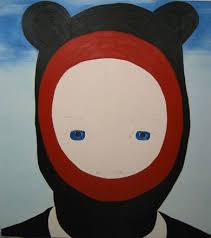
James Rielly.
Subject matters that appear frequently in his work, contrasting against each other, such as adults and children, cover various areas ranging from the usual portraits, middle-class administrator and family album. Furthermore, his twisted depiction of an adult as a child,and a child as a adult signifies definition of general roles of our society as family member, student, officer, and etc. Also he he disquiets stillness by overturning presenting images. The black humours leave audiences with English non-sense and it’s lingering traces.
Rielly does not offer the viewer a simple reading of his work. He leads audiences to have their own experiences and emotional tie and social, relational and structural ironies from their memories. Finally audiences are asked to make their own narratives.
I M ART gallery, Seoul, Korea.www.jamesrielly.com
Lucas Sarah came from the Young British artist movement . Sarah was included in the 198 group exhibition called ' Freeze' withe contemporaries, Angu Fairhurst, Damien Hirst and Gary Hume and Tracey Ermin.
In the early 1990s, Lucas began using furniture as a substitute for the human body. Through her career, Lucas has continued to appropriate everyday materials (including, for example, freshly made fried eggs) to make works that use humour, visual puns and sexual metaphors of sex, death, Englishness and gender.www.lucas sarah.com
self portrait.
Tracey Emin is an a British artist born in 1963 and came from the Young British Artist movement. Tracey Ermin is better known for her exhibitions of 'Everyone I ever Slept with' and My Bed. In 2004 her work was destroyed in a Momart warehouse fire.
Tracey Ermin : Everyone I ever slept with
Tracey Ermin :2001
Jeff Koons is an American Artist born in1955. known for his reproduction of banal objects. Critics are divided , some believes his work is pioneering and is a major historical importance.
Jeff Koons ;Ballon Flower :2006
Damien Hirst was born in England in 1965 and belonged to the Young British Artist movement. He is British Richest living famous artist.
Rob Muek is an Hyper realist sculptor . he began his career on Australian children's televisin program. Mueck was a model maker and puppeteer.. Mueck established his own company in London , making photo realistic props and animatronic for the advertising industry.
In Bed :2005
week: 11
This week Chris talked about photographery and how " how a camera ever lies" , negatives and postive images. How a a image is a different comparison compared to painting. Its more of a recording of life ,history, it makes people think. We talked about Niepce, Daguerre, Henry Fox Talbot,William Henry, Blossfeild, Julien Cameron, Capas barconnormandia, Cunningham, Adam Aspens, Roger Fenton, Edward Weston, Dorothy Lang, Rodchenko Salgado.
First Known Photo. (1826)
Joseph Niepe was a French inventor born in 1765-1833. His was the inventor of the photo above which took eight hours to expose ,so the sun had time to move from east to west,appearing to shine on both sides of the building and he also invented the world's first internal combustion engine.

Daguerre: 1838.
This is a image of the Boulevard du Temple, Paris. Its the first picture with people ,in the bottom left hand corner. One is polishing and one man is having is shoes shined. there is a women and a child in this image but I can't see them.
Henry Fox Talbot.
William Henry Fox Talbot was born in 1800 -1877. He was a British inventor and a pioneer of negative images. He is best known for inventing the calotype process. Talbot was also a member of Parliament for Chippenham between 1832 and 1835 and High Sheriff of Wiltshire in 1840. In 1843 -44 he opened up a shop in Baker Street in Redding to mass produce salted paper prints from calotype negatives.
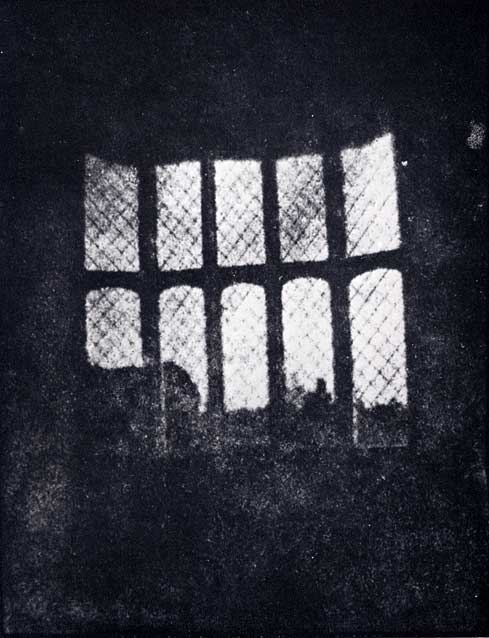
Lathced window; Lacock Abby.1835.
This is the oldest known photographic print of a negative in existence

Kodak Camera 1885
Hill and Adamson.
David Octavius Hill was born in 1802 -1870. He was a painter and arts activist. Hill worked along side Adamson born in 1821- 1848 . He was an engineer and photographer. They worked together between 1843-47 and mainly took pictures of Scotland.
Sir David Brewster commissioned Hill to paint 450 clergyman, but Brewster also wanted images , this is why he introduced Hill to Adamson to each other in 1843. Brewster suggested that they take pictures from the new invention ' photography and record the Disruption Assembly were 450 ministers walked out of the Church of Scotland to form the 'Free Church of Scotland.
Hill and Adamson took images of people in day to day life in Scotland. They took images of Fife landscape and urban scenes, including Scott Monument under construction in Edinburgh.Took images of fishermen and women in Newhavene Church of Scotland.
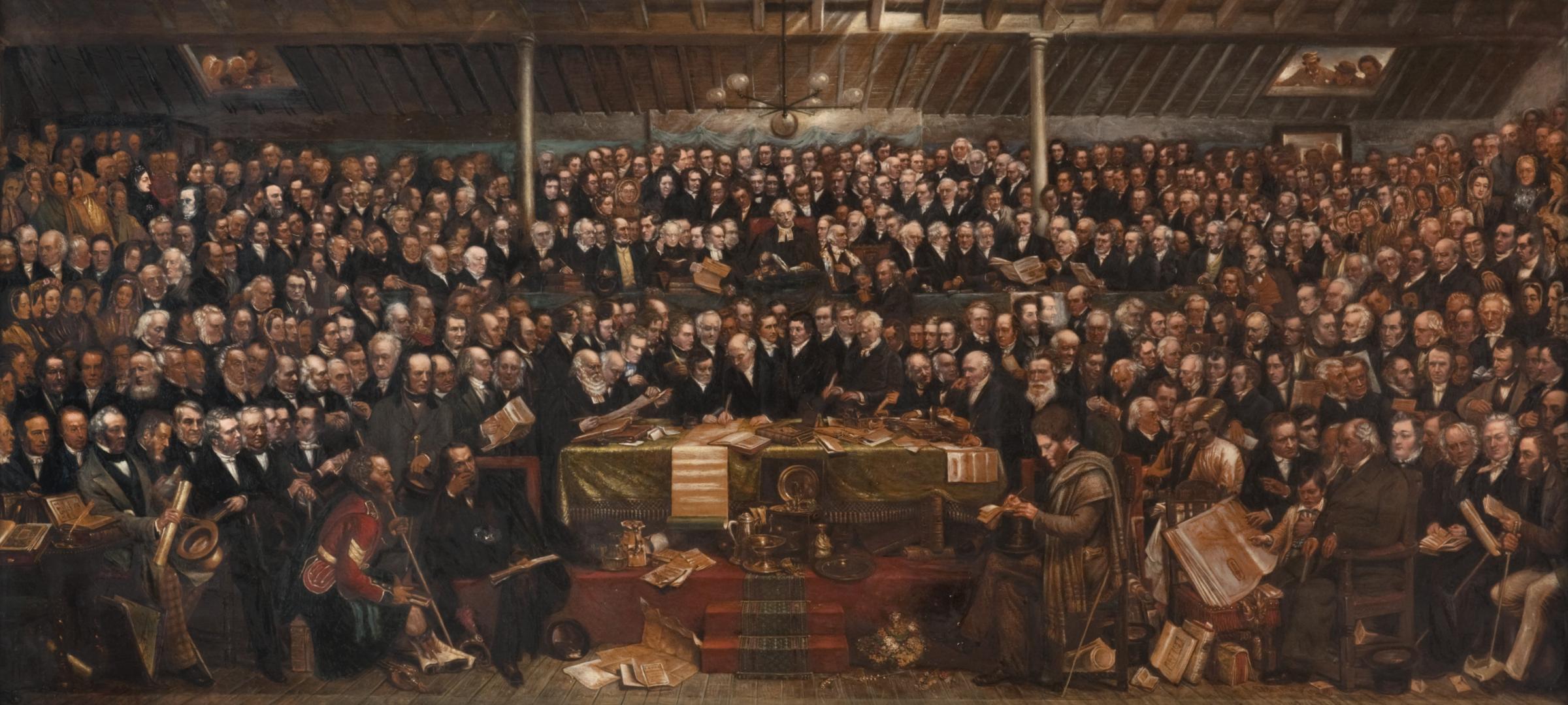
Disruption Assembly , painted by Hill.
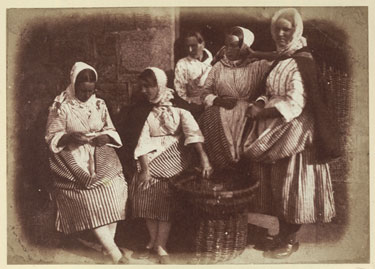
Fisherwives 1845.

Fisherwives St Andrew baiting lines.
Karl Blossfeidt born in 1865 to 1932. He was a German photographer, sculptor,teacher and artist. He is better known for taking images of plants and living things. Blossfeidt made his own homemade camera. He brought out the beauty in nature in plants in a extraordinary way. He also used photography to teach his students about nature.

Maidenhair.
Julie Margaret Cameran made silver prints with wet collodion glassmplate negatives. Best known for takng portrait sittings of family and friend from 1864 -1937. Cameran started photography at the age of 48, when she was give a camera as a present. She was pioneer of modern photography, mainly for close cropped portraits.
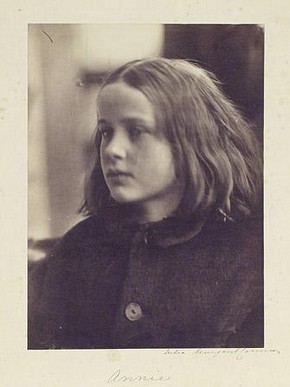

Ellen Terry :1864.
Roger Fenton born in Bury, Lancshire in 1819-1869. Fenton pioneered British photography in the Crimean War. Fentern most well known picture is ' The Valley of Shadow of Death' These two picture below show cannonballs on the road and the other on. Its believed that Ferton placed the
cannonballs on the road for a better effect.


With the cannonballs
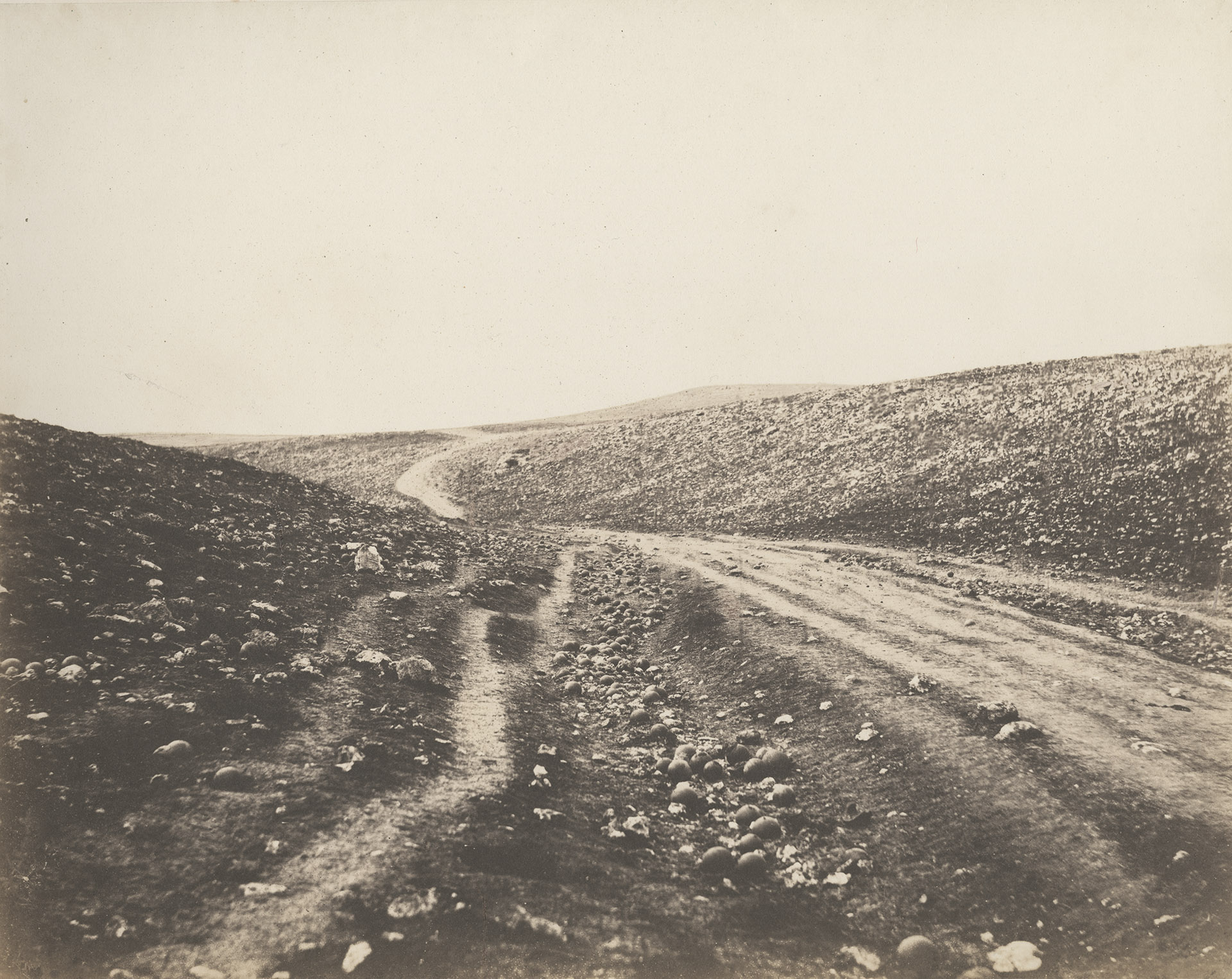
Edward Weston was born in 1886- 1958. He was an American photographer,a pioneer of the 20th century. His images included, landscape, still life, nudes portraits, genre scenes. From my reseach on Weston he had a very colourful life style in regards to his personal life and his photography. I believe that his personal life had a great inpact on his work, and that his photography was more inportant than making money as he only had $300 left in his bank account when he died.

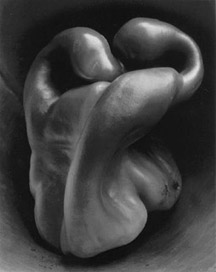
Dorothea Lang was born in 1895-1965. She was an American photographer and photojournalist. She is best known for recording daily struggle's of the Farm Security Administration. This were congress gathered poor farmers and refugees in the great depression.

Alfred Stieglite was born in 1907- 1917, He was an American photographer for over fifty years. Best known for New York galleries. Stieglite wife came from a wealthy background which help to fund Stieglite photography career. Stieglite continued spend more money then he earned which left him in debt several times. Most of the time he made little or no profit.
This picture below his Stieglite best image of his career ,depicting the class divide. The wealthy working class on the top deck and the poor workers below.

Stieglitz's :The streerage.
Sebastiao Salgado was born in 1944 . He is a Brazilian social documentary photographer and photojournalist. He wanted to make a record and show the media what a terrible place the gold mines really were and that the capitalist were profiting and exploiting the worker in many ways so that they could line there own pockets. These men came to work so that they could send money back to their own families, but what happen when they got there was a totally different story. They worked longs hours with little sleep or rest, their employer offered them heroin and a smaller wage. The heroin kept them going and they forgot how hurry and home sick they really were. Many became addicts and though sharing needle most of them contracted HIV and soon died. If this story does,nt put you of buying gold nothing wil.l
Gold Mines

Gold Mines.

Gold Mines


No comments:
Post a Comment